
What Are the 10 Best Warehouse Racking Systems?
Choosing the right Warehouse Racking System can reshape productivity, safety, and storage capacity. A carefully planned layout reduces travel time and protects inventory. Yet the strongest option depends on real operating conditions. There is no universal winner. Product dimensions, turnover rates, available floor space, and handling equipment all influence the decision. A cold-storage facility may need corrosion-resistant materials. A spare-parts warehouse may benefit from dense shelving and clear labeling.
This guide examines ten leading warehouse racking systems and their practical applications. It compares selective pallet racks, drive-in racks, push-back racks, cantilever racks, and other proven designs. The discussion considers access speed, storage density, installation complexity, and long-term maintenance. It also addresses aisle width, beam capacity, forklift clearance, and inventory rotation. These details matter. A rack that looks efficient on paper may slow picking inside a busy facility. Load ratings must match actual pallet weights, not estimates. Ignoring damaged beams or loose anchors creates avoidable risk. Safety cannot be decoration.
Reliable selection begins with accurate measurements and honest workflow analysis. Experienced warehouse teams should verify manufacturer specifications before installation. Applicable safety requirements and inspection procedures also deserve careful attention. Photos, measurements, and traffic observations can reveal problems that a simple floor plan misses. Still, every recommendation has limits. Some facilities may need a mixed system rather than one standard solution. That uncertainty deserves attention. The goal is not merely to fit more pallets. It is to create a dependable storage environment that supports people, equipment, and future growth.
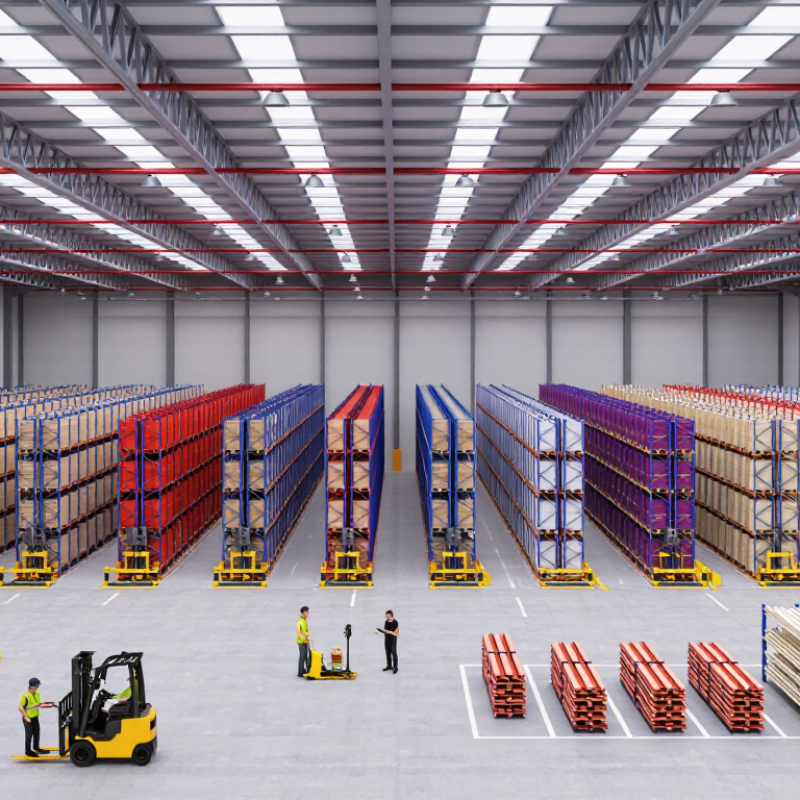
What Makes a Warehouse Racking System Effective?
An effective warehouse racking system begins with operational evidence, not appearance. In field audits, I have seen attractive layouts create long travel paths and hidden congestion. The right design matches pallet weight, SKU velocity, equipment reach, and replenishment frequency. Fast-moving cartons need accessible positions near picking zones. Reserve stock can sit higher or farther away. Clear load plaques, protected uprights, and consistent beam levels also reduce daily uncertainty.
Safety must remain measurable. The U.S. Occupational Safety and Health Administration reports about 85 annual forklift fatalities and 34,900 serious injuries in the United States. Racking design cannot remove every risk, but it can separate pedestrians, widen turning areas, and prevent overloaded bays. Floor anchors matter. So do inspections. A bent frame is not a minor cosmetic issue. It may signal impact damage or poor traffic control.
Technology should support practical decisions. MHI’s 2024 Annual Industry Report surveyed more than 1,000 supply-chain professionals, and 95% said innovation would influence future success. That finding supports better inventory visibility, but automation alone cannot fix poor slotting. Measure pick rate, storage density, replenishment time, damage incidents, and order accuracy before changing the layout. No system is perfect. Seasonal demand, unusual pallets, and rushed workers will expose weaknesses. Leave adjustable space. Review the design after real operations begin, not only after installation.
What Are the 10 Best Warehouse Racking Systems? - What Makes a Warehouse Racking System Effective?
| No. | Racking System | Best Use | Typical Storage Density | Selectivity | Typical Load per Level | Main Advantages | Important Considerations |
|---|---|---|---|---|---|---|---|
| 1 | Selective Pallet Racking | Warehouses requiring direct access to many stock-keeping units (SKUs) | Low to medium | Very high; every pallet position is generally accessible | Approximately 500–5,000 lb (225–2,270 kg), depending on design | Flexible layout, easy inventory control, broad pallet compatibility | Uses more aisles and floor area than high-density systems |
| 2 | Drive-In Racking | Large quantities of the same product with low SKU variety | High | Low; pallets are stored in deep lanes | Approximately 1,500–4,000 lb (680–1,815 kg) | Strong floor-space utilization and efficient storage of uniform loads | Requires careful forklift operation; limited stock rotation and selectivity |
| 3 | Push-Back Racking | Multiple pallets per lane where higher density and faster access are both needed | Medium to high | Medium; normally operates on a last-in, first-out basis | Approximately 1,000–3,000 lb (455–1,360 kg) | Good density, fewer aisles, and faster loading than drive-in storage | Not ideal for strict first-in, first-out inventory rotation |
| 4 | Double-Deep Racking | Facilities seeking more density while retaining access to a reasonable range of SKUs | Medium to high | Medium; requires a reach truck or suitable double-deep equipment | Approximately 1,500–4,000 lb (680–1,815 kg) | Improves space utilization without fully sacrificing pallet access | May increase inventory handling and reduce selectivity for rear pallets |
| 5 | Pallet Flow Racking | Perishable goods or operations that require first-in, first-out rotation | High | High by lane; loading and picking occur from opposite sides | Approximately 1,000–3,000 lb (455–1,360 kg) | Supports FIFO rotation, organized replenishment, and reduced travel distance | Higher initial cost and greater maintenance requirements for rollers and brakes |
| 6 | Carton Flow Racking | Piece-picking operations with fast-moving cartons, totes, or cases | Medium to high | High; individual cartons are replenished from the rear | Approximately 100–750 lb (45–340 kg) per shelf or section | Improves picking speed, product presentation, and FIFO control | Needs correctly sized cartons and regular replenishment planning |
| 7 | Mobile Racking | Cold stores or space-constrained facilities where aisle space must be minimized | Very high | High, but usually only one or a small number of aisles are open at a time | Approximately 1,000–4,000 lb (455–1,815 kg) per pallet position | Can significantly reduce fixed aisle requirements and increase storage capacity | Higher installation cost, slower access, and need for floor and safety controls |
| 8 | Very Narrow Aisle (VNA) Racking | High-bay warehouses with large SKU ranges and high vertical space | High | Very high; most pallet positions remain directly accessible | Approximately 1,500–4,000 lb (680–1,815 kg) | Uses building height efficiently while maintaining strong pallet selectivity | Requires specialized trucks, precise floor tolerances, and operator training |
| 9 | Mezzanine or Multi-Tier Racking | Small-parts storage, order picking, and facilities with unused vertical clearance | High for small items | High for hand-picked inventory | Approximately 250–1,000 lb (115–455 kg) per shelf or bay, subject to engineering | Adds usable storage or work levels without expanding the building footprint | Requires structural review, access protection, stairs, and applicable permits |
| 10 | Cantilever Racking | Long, bulky, or irregular products such as timber, pipe, tubing, and panels | Medium for long products | High; open-front design provides direct access | Approximately 500–6,000 lb (225–2,720 kg) per arm, depending on configuration | Accommodates non-palletized loads and adjustable product lengths | Requires suitable load support, stability controls, and adequate handling clearance |
Note: Load capacities and storage-density descriptions are typical planning ranges only. The final rack design must be verified by a qualified engineer using the actual pallet dimensions, load weights, building conditions, seismic requirements, forklift specifications, and applicable local safety standards.

Our quality management system is registered to ISO 9001: 2015. Our team is dedicated to consistently providing quality service and products to our customers.