| Material | Nitrile Rubber (NBR) | Typical service temperature: approximately −40°C to +120°C. Common hardness range: 70–90 Shore A. | Good resistance to mineral oils, fuels, hydraulic fluids, abrasion, and compression set at moderate temperatures. | Hydraulic and pneumatic equipment, fuel systems, general industrial sealing, and rotating shafts. | Specify acrylonitrile content, hardness, low-temperature requirement, fluid exposure, color, flash control, and dimensional tolerance. |
| Material | Fluorocarbon Rubber (FKM) | Typical service temperature: approximately −20°C to +200°C, with some formulations rated beyond this range. | Excellent resistance to mineral oils, fuels, many chemicals, ozone, and high-temperature aging. | Automotive fuel systems, chemical processing, high-temperature hydraulic equipment, and vacuum service. | Confirm the formulation for steam, hot-water, low-temperature, amine, or concentrated-chemical exposure because resistance varies by compound. |
| Material | Ethylene Propylene Rubber (EPDM) | Typical service temperature: approximately −45°C to +150°C. Excellent ozone and weathering resistance. | Strong resistance to hot water, steam, glycol-based fluids, dilute acids, alkalis, and outdoor aging. | Cooling systems, water valves, sanitation equipment, outdoor machinery, and braking systems using compatible fluids. | Do not use standard EPDM with petroleum oils or hydrocarbon fuels. Define drinking-water, food-contact, or steam requirements separately. |
| Material | Silicone Rubber (VMQ) | Typical service temperature: approximately −60°C to +200°C. Available in multiple grades for special regulatory requirements. | Very wide temperature range, good flexibility, low compression set at moderate conditions, and good weathering resistance. | Medical and food equipment, low-temperature sealing, electrical enclosures, lighting, and static sealing. | Review tear strength, abrasion, gas permeability, steam exposure, pigment requirements, and applicable food or medical compliance. |
| Material | Polytetrafluoroethylene (PTFE) | Typical service temperature: approximately −200°C to +260°C. Usually supplied as a molded, machined, or energized seal. | Very broad chemical resistance, low friction, non-stick behavior, and strong performance in aggressive chemical environments. | Chemical processing, laboratory equipment, high-purity systems, cryogenic service, and high-temperature static sealing. | Account for low elasticity, installation stretch, cold flow, surface finish, backup components, and whether an elastomer energizer is needed. |
| Material | Hydrogenated Nitrile Rubber (HNBR) | Typical service temperature: approximately −40°C to +150°C, depending on compound and application. | Improved heat, ozone, aging, and mechanical strength compared with standard NBR while retaining useful oil resistance. | Automotive air-conditioning systems, oil and gas equipment, high-pressure hydraulic systems, and dynamic sealing. | Define hydrogenated polymer grade, refrigerant or gas compatibility, explosive-decompression resistance, hardness, and pressure-cycle profile. |
| Design | Standard Round O-Ring | Common dimensional systems include ISO 3601 metric sizes and AS568 inch sizes. Cross-sections are selected according to groove geometry. | Simple design, broad availability, economical tooling, and suitability for many static and moderate dynamic applications. | Flanges, covers, fittings, valves, cylinders, pumps, and general-purpose enclosures. | Provide groove diameter, seal diameter, cross-section, gland fill, squeeze, stretch, pressure, and installation direction rather than relying only on nominal size. |
| Design | X-Ring or Quad-Ring | Four-lobed cross-section designed to create two sealing lines and reduce rolling in some dynamic applications. | Can reduce twisting and rolling during reciprocating or rotary movement when the groove is correctly designed. | Hydraulic rods, rotary shafts, actuators, and applications where a conventional O-ring may spiral or roll. | Use a groove designed specifically for the X-ring profile; verify clearance, lubrication, movement speed, surface finish, and extrusion risk. |
| Design | Back-Up Ring Assembly | An elastomer O-ring is paired with one or more rings made from PTFE or another harder material to limit extrusion. | Improves resistance to high pressure, large clearances, and pressure cycling compared with an unprotected O-ring. | High-pressure hydraulics, pneumatic equipment, valves, and systems with pressure reversal or extrusion risk. | Specify pressure, temperature, clearance gap, pressure direction, groove dimensions, backup-ring split style, and installation sequence. |
| Design | Encapsulated O-Ring | An elastomer core is enclosed by a seamless or jointed fluoropolymer jacket; common core options include FKM or silicone. | Combines elastomeric resilience with improved chemical resistance and a low-friction outer surface. | Chemical processing, pharmaceutical equipment, semiconductor manufacturing, and aggressive-fluid service. | Match jacket material, core elasticity, temperature limits, compression level, corner radius, and installation method. |
| Design | Metal-Detectable or Conductive O-Ring | Elastomer compound contains functional fillers or conductive additives selected for detection or electrical performance. | Can support contamination control, grounding, static dissipation, or electromagnetic shielding requirements. | Food-processing lines, pharmaceutical production, electronics, instrumentation, and controlled manufacturing areas. | Define detection method, minimum detectable fragment, electrical resistance, regulatory requirements, hardness, and compatibility with cleaning chemicals. |
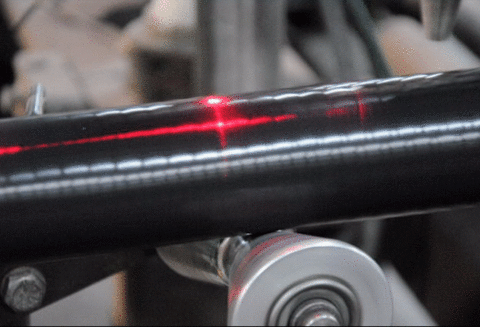
| Quality | Dimensional and Visual Inspection | Typical controls include inside diameter, cross-section, flash, surface defects, mold parting line, and batch traceability. | Reduces assembly failures caused by incorrect size, surface damage, excessive flash, or inconsistent molding. | All custom O-ring programs, especially safety-critical, high-volume, and automated-assembly applications. | Agree on sampling plans, inspection equipment, drawing tolerances, appearance limits, lot identification, and certificate requirements. |
| Validation | Performance and Compatibility Testing | Potential tests include compression set, tensile properties, hardness, fluid immersion, leakage, pressure cycling, and temperature aging. | Confirms that the selected compound and geometry perform under the buyer's actual operating conditions. | New product development, fluid changes, elevated pressure, wide temperature cycles, and regulated applications. | Set acceptance criteria before production and test against actual fluid, pressure, temperature, speed, surface finish, and installation conditions. |