A partner you can trust
Global buyers comparing the Top 10 Aluminum Solar Rail Suppliers need more than a list of product names. Rail choice affects module support, installation time, shipping weight, and long-term maintenance. A profile that looks suitable on a screen may not match the roof, clamp system, or project conditions on site. Small details matter. A slot that is hard to align can slow a crew across an entire array.
For this introduction, solar mounting specialist Maya Chen offers a practical guiding line: “A rail is only as reliable as its fit, finish, and connection to the full mounting system.” Buyers should verify alloy and temper details, dimensions, surface treatment, load documentation, and compatibility with modules and clamps. They should also ask how suppliers handle samples, packaging, lead times, and quality checks. These questions help distinguish a polished catalog from a dependable supply partner.
Price still matters. But the lowest quote can leave gaps in documentation or support. Not every project needs a custom profile, either. That distinction is easy to miss. This guide compares suppliers through product range, manufacturing capability, export experience, customization, and buyer support. It also recognizes a limitation: supplier information can change, and published specifications do not replace project-specific engineering review. Use the ranking as a starting point, then confirm current details directly with each supplier before making a purchasing decision.
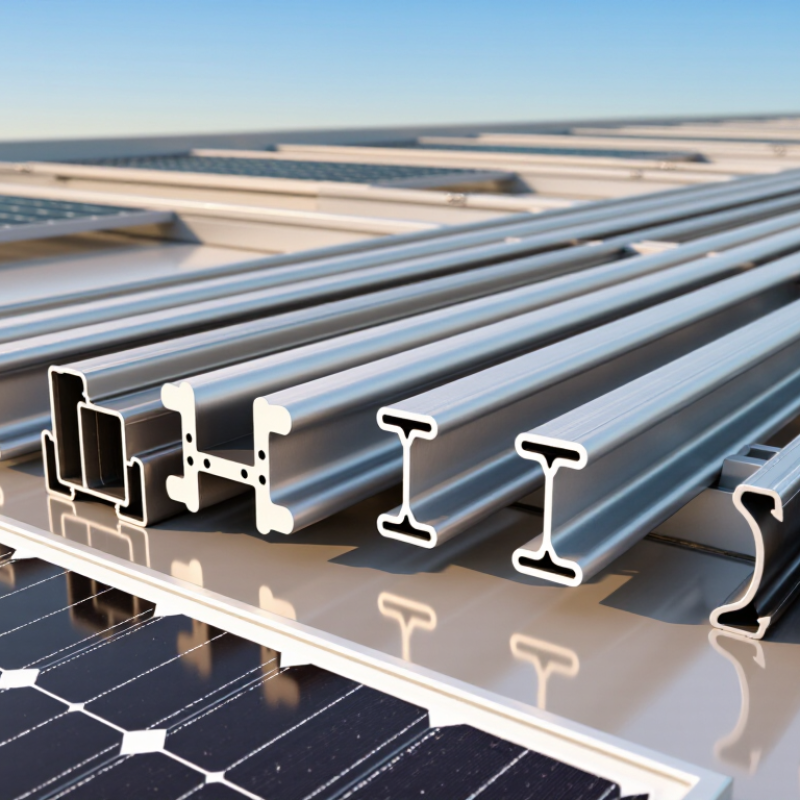
Aluminum solar rails are structural extrusions that support modules and transfer loads to mounting points. Their density is approximately 2.70 g/cm³, though the exact value can vary slightly with alloy composition. This relatively low mass helps reduce handling effort and roof loading.
That matters.
Many rails use 6063 aluminum alloy because it extrudes into consistent profiles and can provide a clean surface finish. The alloy designation alone does not tell the whole story. Temper, such as T5 or T6, affects mechanical properties, so buyers should check the supplier’s technical data.
Not a strength rating.
Rail geometry, wall thickness, and span also influence performance.
When comparing suppliers, review dimensional tolerances, material certificates, finish quality, and test information for the intended installation conditions. Look closely at the slot edges and cut ends; burrs or uneven coating can complicate assembly.
A common oversight is focusing too heavily on the 6063 label.
I would question that.
Density describes mass per volume, not load capacity, and a lighter rail is not automatically the better choice. Ask for documented values and have the design checked against project-specific loads.
Global solar growth makes rail quality a practical procurement issue. IEA PVPS estimated at least 456 GW of new photovoltaic capacity was installed in 2023. SolarPower Europe reported 447 GW for the same year, reflecting differences in market estimates.
For buyers comparing aluminum rail suppliers, ASTM B221 is a useful starting point. It covers extruded aluminum bars, rods, profiles, and tubes. But citing the standard alone does not prove a rail meets the required structural performance. Details matter. Request material certificates that identify alloy, temper, mechanical properties, and dimensional tolerances, then match them to the quoted rail section.
Ask for structural test reports tied to the actual rail profile and connection details. Useful evidence includes test spans, support spacing, fastener torque, applied load, deflection, and permanent deformation after unloading. Wind or snow load assumptions should also be stated, not left in a sales sheet.
Check whether the test setup reflects field conditions, including rail joints and module clamps. A strong result on a short sample may not translate to a long installed span. I would also verify report dates and sample identification; this step is easy to overlook. If calculations replace full-scale testing, request the assumptions and independent review behind them.
A useful comparison of ten global aluminum solar rail suppliers starts with alloy, not catalog photos. Record the stated grade, temper, and supporting material documents. Alloys such as 6005-T5 or 6063-T6 can differ in strength, machinability, and extrusion behavior. Confirm the actual specification for each rail. Do not assume similar-looking sections perform alike.
Next, compare rail profiles and manufacturing capacity. Note whether each supplier offers open channels, enclosed sections, or multiple mounting interfaces. Check wall thickness, slot dimensions, and finish against the project drawings. Ask for production capacity, minimum order quantities, and typical lead times. A large stated capacity does not guarantee an available production slot. That matters.
Reach is another practical measure. Compare export destinations, shipping options, and the supplier’s ability to provide consistent documentation. Ask how it controls dimensional tolerances between batches. Where possible, review sample rails and inspect cut edges, coating uniformity, and connector fit. These checks take time. The comparison is not perfect: public capacity figures may be dated, and alloy claims need verification. A clear scorecard helps buyers spot gaps before requesting final quotations.
Supplier capacity and export reach are not consistently published in comparable formats. This chart therefore compares typical minimum tensile and yield strengths for commonly used extrusion alloys—not individual suppliers or a supplier ranking.
Values shown in MPa are indicative minimums for common extrusion product specifications. Actual requirements can vary with the governing standard, product dimensions, and temper. Confirm values against the supplier’s current material certificate and product datasheet.
When comparing the top 10 aluminum solar rail suppliers, check whether each system suits the actual installation site. Wind pressure, snow depth, roof type, and exposure to salt or industrial pollutants all affect rail selection. Ask for load tables, alloy and finish details, and compatible clamp specifications. A rail that performs well inland may need different corrosion protection near the coast. Small details matter.
Tips: Share the project location, roof dimensions, module layout, and expected loads when requesting a quote. Ask how the stated capacities were tested and what spacing assumptions apply. Keep the answers with your project records.
Review both the rail and its connection points. End clamps, mid-clamps, splices, and roof attachments must work as a system under site-specific loads. For snowy regions, confirm design assumptions for drift and uneven accumulation, not only uniform snow. Coastal projects may require closer attention to coating condition and cut edges. Supplier documents are useful, but they may not capture every roof irregularity. Treat initial comparisons as screening, then have a qualified project professional check the final design against measured site conditions. I would not rely on a generic load rating alone.
| Supplier Profile | Typical Offering | Wind-Load Suitability Checks | Snow-Load Suitability Checks | Corrosion and Material Checks | Evidence to Request Before Purchase |
|---|---|---|---|---|---|
| 01 — Integrated aluminum extruder and rail fabricator | Extruded rails, cut-to-length services, and related clamps or connectors. | Request project-specific structural calculations, allowable spans, support spacing, and design assumptions for local wind actions. | Confirm rail, splice, and attachment capacity for the project’s snow actions and roof configuration. | Verify alloy and temper, finish specification, and compatibility of dissimilar metals and fasteners. | Material certificates, profile drawings, load calculations, finish documentation, and quality-system records. |
| 02 — Solar mounting-system manufacturer | Rails designed as part of a coordinated rooftop or ground-mount system. | Check that calculations cover the complete load path, including modules, clamps, rails, connections, and anchors. | Check system configuration, module orientation, support spacing, and local snow-load assumptions. | Review published material and coating specifications for the intended exposure and service environment. | System design guide, engineering calculations, installation instructions, and applicable test reports. |
| 03 — Rooftop mounting specialist | Rail and attachment options for pitched or flat-roof installations. | Confirm roof-zone pressures, edge and corner effects, attachment capacity, and substrate condition are addressed. | Confirm roof slope, drift or accumulation conditions, and roof attachment capacity are considered by the project engineer. | Check compatibility with roofing materials, sealants, and the site’s atmospheric exposure. | Roof attachment details, waterproofing instructions, project calculations, and approved installation details. |
| 04 — Ground-mount rail and structure supplier | Rails or purlins for fixed-tilt ground-mounted solar structures. | Request calculations for wind pressure, uplift, frame geometry, foundations, and site exposure. | Confirm snow loading is included where applicable, along with frame and foundation load paths. | Check soil and atmospheric exposure separately; confirm the specified protection for steel components and aluminum interfaces. | Structural package, foundation assumptions, connection details, material specifications, and installation tolerances. |
| 05 — Custom-profile extrusion supplier | Project-specific rail sections produced from custom or adapted extrusion dies. | Have a qualified engineer assess the proposed section, connections, and support spacing for the project loads. | Obtain section properties and engineering calculations for the required snow actions and span arrangement. | Specify alloy, temper, surface treatment, and acceptance requirements in the purchase documents. | Certified section properties, dimensional drawings, material certificates, and production inspection records. |
| 06 — Regional mounting-system distributor | Locally stocked rails and compatible mounting components from multiple manufacturers. | Verify that the offered system has calculations and approvals applicable to the project’s jurisdiction and wind conditions. | Confirm the exact rail and accessory configuration is covered by the supporting engineering documents. | Check traceability of supplied materials and suitability of finishes for the installation location. | Manufacturer identity for traceability, current technical documents, batch records, and local support arrangements. |
| 07 — Contract extrusion and fabrication partner | Buyer-specified extrusion, cutting, machining, and packaging services. | Do not treat fabrication capability as proof of structural suitability; obtain independent system calculations. | Confirm the buyer’s design specifies required section properties and verification responsibilities. | Define alloy, temper, finish, handling, and protection requirements in the technical specification. | Process controls, material traceability, dimensional inspection results, and agreed acceptance criteria. |
| 08 — Corrosion-focused coastal project supplier | Rail and connection packages proposed for marine or otherwise aggressive environments. | Assess wind actions independently for the site; coastal location alone does not determine design wind load. | Assess snow actions independently where relevant; do not infer capacity from corrosion specifications. | Specify the exposure basis, aluminum alloy and finish, fastener material, and galvanic-isolation details. | Exposure assessment, material and finish data, fastener specifications, and written compatibility guidance. |
| 09 — High-snow-region project supplier | Mounting components marketed for projects where snow actions may govern design. | Request separate wind calculations for the actual site, roof zones, array layout, and attachment substrate. | Require project-specific calculations for snow actions, accumulation or drift conditions, and the full load path. | Confirm corrosion protection is suitable for local moisture, de-icing exposure, and maintenance conditions. | Signed engineering calculations, applicable design standard, installation details, and limits of use. |
| 10 — International project-package supplier | Coordinated rail, clamps, connectors, and documentation for cross-border procurement. | Confirm calculations use the project’s governing code, site data, and required safety factors. | Confirm snow actions and combinations follow the project jurisdiction’s applicable design basis. | Check material and finish requirements against the destination environment and local project specifications. | Country-specific compliance documents, traceable material records, technical support scope, and warranty terms. |
These are supplier categories, not named or ranked companies, and the table does not assert supplier-specific capacities. Wind and snow suitability cannot be determined from a rail description alone; request calculations based on the site, applicable design code, array layout, roof or foundation conditions, and complete connection load path. Corrosion suitability depends on the exposure environment, materials, finishes, and interfaces. Verify all project requirements with the supplier and the project’s qualified engineer before procurement.
A credible Top 10 ranking should show how each aluminum solar rail supplier performs, not just compare catalog prices. Check whether rail batches can be traced to alloy and temper records, with labels that remain readable after delivery. Ask for sample inspection reports and clear links between production lots and shipping documents. Paper trails matter. Lead times should distinguish stocked sections from custom extrusions, tooling, and freight. A quoted date is not a delivered rail. For a project, confirm the expected arrival of bundled rails, clamps, and splice connectors together; missing small parts can delay installation.
Warranty terms deserve close reading. Compare coverage periods, exclusions, claim evidence, and who pays for replacement freight. Then estimate lifecycle cost, including cutting waste, corrosion resistance for the site, packaging damage, and the labor needed to fit each profile. Cheap can become expensive. A supplier with a slightly higher quote may offer better traceability and steadier replenishment. Still, rankings are imperfect: factory records do not guarantee every shipment is flawless. Request a small trial order, inspect rail straightness and finish, and record actual delivery dates before committing to a large volume. These checks make supplier comparisons more useful than broad claims about quality or capacity.
This content is restricted to site members. If you are an existing user, please log in. New users may register … LEARN MORE “Lighting Power & Control-Signal Cable”
We are here to help. You can contact us or create an account online to have access to special products, technical specifications and our new online quote tool.
ELECTRO CABLES
9 Riverside Drive
P.O. Box 276
Trenton, Ontario
CANADA K8V 5R5
N.A. Toll Free: 888-ELECTRO
(1-888-353-2876)
World: 613-394-4896
Fax: 613-394-4101
Email: sale@machinecables.com
We manufacture cables that are certified by the Canadian Standards Association (CSA), listed by Underwriters Laboratories and/or listed by Intertek (ETL).
Our quality management system is registered to ISO 9001: 2015. Our team is dedicated to consistently providing quality service and products to our customers.

© 2025 ELECTRO CABLES • SITE BY SNAP 360•