Electro Cables
Login

7 Best Carton Suction Cups for Packaging Machines

Carton handling looks simple until a packaging line starts missing picks or slipping sheets. A Carton Suction Cup is a small component with an outsized role in keeping cartons moving steadily. It must seal against the carton surface, release cleanly, and tolerate repeated cycles. Yet cartons are not uniform: recycled stock may be dusty, coated board can be slick, and seams or print can interrupt contact. A cup suited to one box may perform poorly on another. Small details matter.

This guide compares seven carton suction cup options for packaging machines. It focuses on practical selection factors, including carton type, payload, operating pace, vacuum compatibility, and replacement needs. Product labels alone cannot guarantee performance. Treat manufacturer specifications as a starting point, then check cup dimensions and material against the cartons you actually handle. Confirm pickup and release behavior under normal line conditions. Dust, temperature, and carton variation can change results. That is easy to overlook. A shortlist cannot replace a controlled trial on your own equipment. Still, no shortlist is perfect. The right choice usually balances dependable handling with reasonable service life and straightforward maintenance. Operating conditions differ, so verify product claims before making a change.
7 Best Carton Suction Cups for Packaging Machines

Assess Carton Porosity, Surface Texture, and Payload Before Selecting Cups

Cartons can look alike while behaving differently under vacuum. Recycled corrugated board may leak air through exposed fibers, seams, or crushed edges. On porous stock, a cup with a soft sealing lip or a larger contact area may help maintain grip. Yet a larger cup cannot always bridge deep flute marks. Test several locations on the actual carton.

Surface texture matters too. Glossy coatings can be smooth but uneven, while rough kraft paper may disrupt the seal. Check for dust, labels, tape, and printed areas where the cup will land. Easy to miss. A cup placed partly over a seam may hold during a slow trial and slip when the line accelerates. A clean sample can flatter the result.

Payload means more than carton weight. Include contents, cup orientation, acceleration, and the force from lifting or turning the package. Select cups with suitable load capacity, then verify performance at normal machine speed. Watch for gradual vacuum loss, carton deformation, and marks left on the surface. If results vary between batches, record the board type and test more than one carton. That extra check takes time, and it can still miss a rare defect.

Compare 7 Cup Types: Flat, Bellows, Oval, Foam, Multi-Bellows, Deep, and Custom

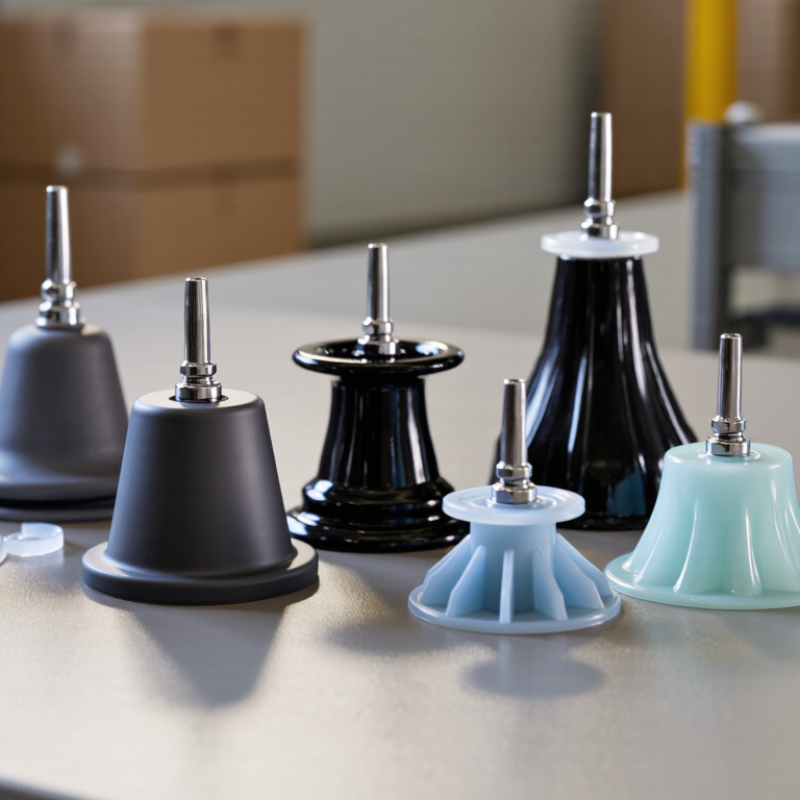
Flat cups suit smooth, rigid cartons with broad, even surfaces. Their shallow profile keeps pickup stable and limits movement during fast transfers. They may struggle with warped panels or dusty coatings.

Bellows cups compress to accommodate height changes and uneven carton faces. Multi-bellows versions offer greater travel for stacked blanks, but can feel less stable at high speeds. Oval cups spread grip along narrow flaps or elongated carton edges. Check that the sealing lip stays clear of folds.

Foam cups conform to rough, porous, or slightly textured stock. They can seal where a standard rubber lip leaks, though foam may wear faster and needs regular inspection. Deep cups reach recessed areas, such as formed carton pockets, but their shape must match the available clearance. Custom cups can combine a special contour, material, or mounting position for unusual packaging. They cost more and may take longer to replace. A small mismatch matters.

In practice, carton stiffness, surface finish, vacuum level, and machine cycle all affect results. Test with real cartons, including the weakest ones in the stack. I have seen a cup work perfectly on a sample, then slip on a slightly bowed production carton. That is annoying, but useful feedback. Check pickup consistency and carton marks before settling on a cup type.

Match Cup Materials to Carton Dust, Oil, Temperature, and Wear Conditions

Carton suction cups need to match the surface, not just the machine’s vacuum level. Paper dust can settle on the sealing lip and cause slow leaks. Dust changes everything. A soft, wide lip may seal better on rough board, while a clean, smooth carton can work with a firmer cup. Check for dust buildup during real production runs, not only on a clean sample.

Natural rubber suits many dry, standard cartons and offers a flexible grip. Nitrile rubber is a practical choice when cartons carry traces of oil. Silicone tolerates higher temperatures, but confirm its limits against the actual line temperature. Polyurethane often handles abrasion well where cups cycle repeatedly. EPDM can suit warm, humid conditions, though it is a poor match for oil exposure. PVC may serve light-duty handling on smoother cartons. For porous or uneven board, a foam-faced cup can improve contact, but may wear faster.

No material wins in every condition. That chart can mislead. Carton coatings, dust levels, and cup pressure all change performance. Test several cups on production cartons, including dusty ones, and track missed picks and visible wear. Inspect the lip regularly; a small nick can turn a reliable seal into an intermittent problem. Temperature ratings and service life vary by compound and supplier, so verify the technical data before specifying a replacement.

Calculate Grip: F = ΔP × A; a 50 mm Cup at 60 kPa Gives 118 N Theoretically

For a carton suction cup, estimate the theoretical holding force with F = ΔP × A. Here, ΔP is the pressure difference in pascals, and A is the cup’s effective contact area in square metres. A 50 mm circular cup has an area of about 0.001963 m². At a 60 kPa pressure difference, the calculation is 60,000 × 0.001963, or roughly 118 N. That is the ideal force, not a guaranteed payload.

The number is theoretical. Real cartons have seams, dust, printing texture, and porous surfaces that can weaken the seal. A slightly bowed panel may also leave a small leak beneath the cup rim. Cartons vary. In a packaging machine, acceleration and off-centre lifting add forces that the simple equation does not include. Use the calculation to compare cup sizes, then test the actual carton under operating conditions. Watch for vacuum loss during pickup, and check whether the cup distorts the carton face. A safety margin is essential; the precise margin depends on carton quality, machine speed, and vacuum stability. The neat calculation helps, but it can still mislead if the contact area is smaller than expected.

7 Best Carton Suction Cups for Packaging Machines - Calculate Grip: F = ΔP × A; a 50 mm Cup at 60 kPa Gives 118 N Theoretically

Theoretical normal-force estimates for common cup shapes and sizes. Calculations use F = ΔP × A, with nominal projected area and the stated vacuum pressure differential.

Cup Type Nominal Size Example Vacuum Differential Projected Area Used Theoretical Grip Force Typical Carton-Packing Use Practical Considerations
Flat round cup 30 mm diameter 60 kPa 707 mm² 42 N Small, flat carton panels and light pick-and-place tasks Works best on smooth, even surfaces; limited ability to compensate for panel curvature.
Bellows round cup 40 mm diameter; single bellows 50 kPa 1,257 mm² 63 N Cartons with modest height variation or slightly uneven panels The bellows helps accommodate height differences; avoid excessive compression during pickup.
Deep-bellows round cup 50 mm diameter; multiple bellows 60 kPa 1,963 mm² 118 N Pickup where extra compliance is useful, such as uneven or recessed carton areas Greater compliance can help maintain contact, but the nominal force is not a rated working load.
Oval cup 30 × 60 mm 50 kPa 1,414 mm² 71 N Narrow carton flaps or elongated contact areas Align the long axis with the available flat area and keep the sealing lip clear of folds.
Large oval cup 40 × 80 mm 50 kPa 2,513 mm² 126 N Larger panels where an elongated footprint fits better than a round cup Requires a sufficiently broad, unobstructed sealing area; porous board can reduce achievable vacuum.
Rectangular cup 50 × 100 mm 40 kPa 5,000 mm² 200 N Broad carton surfaces and applications needing a rectangular contact footprint Check that the full perimeter can seal without crossing seams, creases, or damaged board.
Large flat round cup 80 mm diameter 40 kPa 5,027 mm² 201 N Large, relatively flat carton panels with enough clear surface area A larger cup needs more surface clearance and may be more affected by panel flexibility.

Important: These are ideal theoretical forces calculated from nominal projected area (circular area = πd²/4; oval area = πLW/4; rectangular area = LW). Actual holding force can be lower because of carton porosity, surface texture, leakage, cup deformation, acceleration, and load direction. Validate the cup and safety margin under the machine’s real operating conditions.

Validate Vacuum Flow and Cycle Performance Under ISO 4414 Safety Principles

A carton suction cup can hold firmly on a clean sample and still slip during a fast production cycle. Corrugated board leaks air through its surface, while warped flaps and dusty print areas make the seal less predictable. Test cups on the actual carton, not just a smooth test plate. Record vacuum level, airflow, pickup time, and release time across several cycles. Watch the carton corners. A small lift can become a dropped case when the conveyor accelerates.

ISO 4414 provides safety principles for pneumatic systems; it does not certify a cup’s gripping performance. Apply its risk-based approach to the vacuum circuit: provide accessible isolation, control stored energy, and prevent unexpected motion during maintenance. Check that tubing, valves, filters, and generators can supply the required flow without creating excessive pressure loss. Then run repeated pick-and-place trials at the intended speed, including the heaviest and most porous cartons. Keep a margin for wear and changing board quality. Real lines are rarely as tidy as test benches. One weak point is easy to miss: operators may adjust vacuum settings to mask a poor seal. Recheck the cause before raising the setting, and document the final test conditions.

Lighting Power & Control-Signal Cable

This content is restricted to site members. If you are an existing user, please log in. New users may register … LEARN MORE “Lighting Power & Control-Signal Cable”