A partner you can trust
A dependable Ro Water Filter should solve a measured water problem, not merely look impressive beneath the sink. For a family, that may mean better-tasting water from a kitchen tap. For a café or small office, it may mean steady output during busy hours and predictable filter changes. The right choice depends on source water, daily demand, installation space, and maintenance—not a bold claim on a product page.
Water-quality expert Dr. Joseph Cotruvo’s guidance can be paraphrased this way: match treatment to identified contaminants, then verify the system’s performance. That is not a direct quotation. It is a useful standard for comparing reverse osmosis systems. Check independent certifications, contaminant-reduction data, replacement costs, and the manufacturer’s instructions. A test result matters more than a vague promise. Test the water first.
This guide examines what makes a 2026 RO system practical for homes and businesses, including capacity, waste-water ratios, storage, and service needs. A compact unit may suit a household but struggle behind a busy coffee counter. A high-output system may be excessive for a small apartment. Small details count: a crowded cabinet, a slow refill, or an overdue cartridge can change the experience. That is easy to overlook—and buyers sometimes do. No filter fits every building, and even a well-chosen system needs upkeep. The goal is a clear, evidence-based choice, with room to reconsider when water conditions or demand change.
2026 Best RO Water Filter for Home and Business?
Reverse osmosis separates water through a semi-permeable membrane. Pressure pushes water through while the membrane rejects many dissolved salts and other contaminants. The concentrated reject stream then flows to drain. Performance depends on source water, pressure, temperature, and membrane condition. TDS readings can track changes, but they do not identify every contaminant or prove water is safe. Test for relevant substances before choosing a system.
Pretreatment helps the membrane last. A sediment filter catches grit that could clog it; carbon may reduce chlorine that can damage certain membrane materials. Hard water may need scale control, especially in systems running for long hours. Not every site needs the same setup. A home system may serve a small storage tank, while a business needs capacity matched to peak demand and recovery time. Post-treatment can include taste adjustment, remineralization, or disinfection, depending on water testing and intended use. Keep records of pressure, production, and filter changes. Small details matter. A neglected storage tank or overdue cartridge can undermine otherwise sound equipment. And specifications are not guarantees; actual water conditions deserve a second look.

EPA’s National Secondary Drinking Water Regulations set a secondary limit of 500 mg/L for total dissolved solids (TDS). This is an aesthetic guideline, not a federal health-based safety threshold. The EPA’s 2009 Edition of Drinking Water Standards and Health Advisories links elevated TDS with salty or mineral-like taste, deposits, and staining. That distinction matters. A reading above 500 mg/L does not, by itself, prove water is unsafe; it signals that taste, scaling, or equipment performance may deserve attention.
For a household, that can mean white crust around a kettle. In a café or workshop, mineral deposits may build up in heaters and plumbing. Test the tap. A lab report can identify TDS and specific dissolved minerals, while a handheld meter offers only a quick estimate based on electrical conductivity. Reverse osmosis can reduce many dissolved substances, but results depend on the feed water, membrane condition, and maintenance. I would not treat 499 mg/L as perfect or 501 mg/L as a crisis; the cutoff is useful, but blunt. Compare test results with the EPA guideline and the water’s actual taste, scale, and intended use before choosing a system.
Water-Quality Baseline: EPA’s 500 mg/L Secondary TDS Limit
The 500 mg/L line is the U.S. EPA’s secondary drinking-water standard for total dissolved solids (TDS). Secondary standards address aesthetic qualities such as taste and scaling; they are non-enforceable federal guidelines. The bars are arithmetic reference points (0.5×, 1×, 1.5×, and 2× the standard), not measured water samples. Test your source water and treated water to assess an RO system’s performance.
Source: U.S. EPA, Secondary Drinking Water Standards — https://www.epa.gov/sdwa/secondary-drinking-water-standards-guidance-nuisance-chemicals
For a 2026 home or business system, a TDS-reduction claim should be backed by testing to NSF/ANSI 58, not just a product-page number. NSF’s standard covers reverse osmosis systems and includes a minimum 75% TDS reduction requirement for certification. Testing uses defined conditions; household results can differ with feed-water quality, pressure, temperature, and membrane age. A handheld meter can show a before-and-after reading, but it cannot prove that a system meets the standard. The certification record matters.
Look for an independent certification listing that names the exact model and confirms the TDS-reduction claim. NSF/ANSI 58 also addresses system performance and material safety, while some contaminant-reduction claims are evaluated separately. Don’t assume that “NSF tested” means every advertised contaminant was certified. That wording can be easy to misread. For a café or office, record incoming and treated-water readings during routine maintenance, and replace filters according to the manufacturer’s schedule. TDS is a useful measure of dissolved ions, not a complete measure of drinking-water safety.
Tips: Ask for the model’s NSF/ANSI 58 listing and the certified TDS-reduction figure. Compare readings with the same meter, then retest after filter changes. Small details count.
| Verification dimension | What to check | Acceptance or interpretation | Evidence to request |
|---|---|---|---|
| Applicable standard | NSF/ANSI 58 covers point-of-use reverse osmosis drinking-water treatment systems, including TDS-reduction performance. | Confirm the exact system model and configuration are certified to NSF/ANSI 58; certification of a component alone does not establish certification of the complete system. | A current certification-directory listing or certificate naming the complete system model and standard. |
| TDS reduction claim | Compare feed-water TDS with treated-water TDS using measurements taken under the applicable test protocol. | NSF/ANSI 58 includes a minimum 75% TDS-reduction requirement for systems evaluated for this performance claim. Verify certification and the claim for the specific model. | Test report or certification documentation stating the TDS-reduction result and test conditions. |
| Calculation | TDS reduction (%) = [(feed-water TDS − treated-water TDS) ÷ feed-water TDS] × 100. | Example arithmetic only: 500 mg/L feed and 125 mg/L treated water gives 75% reduction. This is not a measured result or a product certification. | The original paired readings, units, sampling points, and calculation—not just a percentage in advertising. |
| Test conditions | TDS readings can vary with feed-water composition, pressure, temperature, membrane condition, and system operation. | Compare results only when the sampling and operating conditions are documented and appropriate to the applicable standard or stated test method. | Test method, feed-water details, operating pressure and temperature, stabilization procedure, and sampling locations. |
| Measurement quality | Use a suitable, maintained TDS/conductivity meter and take representative feed and treated-water samples. | A handheld meter reading is useful for operational checks but does not, by itself, prove NSF/ANSI 58 certification or laboratory-tested performance. | Meter calibration or quality-control records, repeat readings, and a dated sampling log. |
| Other contaminant claims | TDS is a broad measure of dissolved substances; it does not identify which substances are present or establish their health risk. | Do not infer reduction of a specific contaminant from a TDS result. Check each contaminant claim and its test or certification evidence separately. | Claim-specific performance data and certification scope for each named contaminant. |
| Home and business fit | Compare rated daily production, storage capacity, recovery/wastewater information, maintenance needs, and expected demand. | Select capacity for the site’s peak demand and source-water conditions. A certification or TDS result alone does not establish suitability for a particular business. | Published capacity and operating limits, installation requirements, replacement schedule, and service plan. |
Note: A certification claim should be checked against the certifier’s current public listing. TDS-reduction performance is not a substitute for water testing or for verifying contaminant-specific treatment claims.
Rated gallons per day (GPD) is a starting point, not a guarantee of water at the tap. USGS Circular 1441 reports average U.S. domestic water use of 82 gallons per person per day in 2015. That figure includes uses such as bathing and laundry, so it should not be treated as a home’s purified-water requirement. Measure drinking, cooking, and appliance demand instead. Peak hours matter.
For a household, note how many people may fill bottles, cook, or use an ice maker at once. For a café or office, track the busiest hour, not just the daily total. If measured peak use is 8 gallons in an hour, a system producing 50 GPD would make only about 2.1 gallons per hour under an even, idealized rate. A storage tank can cover short bursts, but it cannot fix a sustained production shortfall.
Check the conditions behind the GPD rating on the product data sheet. Feed-water temperature, pressure, and dissolved solids can affect actual output, and performance may decline as a membrane ages. Leave room for that gap. I would compare measured peak demand with conservative expected production, then confirm tank recovery time during busy periods. The USGS figure is useful context, but it is not a sizing shortcut. A small demand log often beats a guess.
Choosing a 2026 RO system starts with measurable trade-offs, not advertised “purity.” The U.S. EPA’s consumer guidance notes that some point-of-use reverse-osmosis systems can waste up to five gallons for every gallon treated. Compare the stated recovery ratio under similar feed-water pressure. A low number in a brochure is not a guarantee. Real kitchens vary.
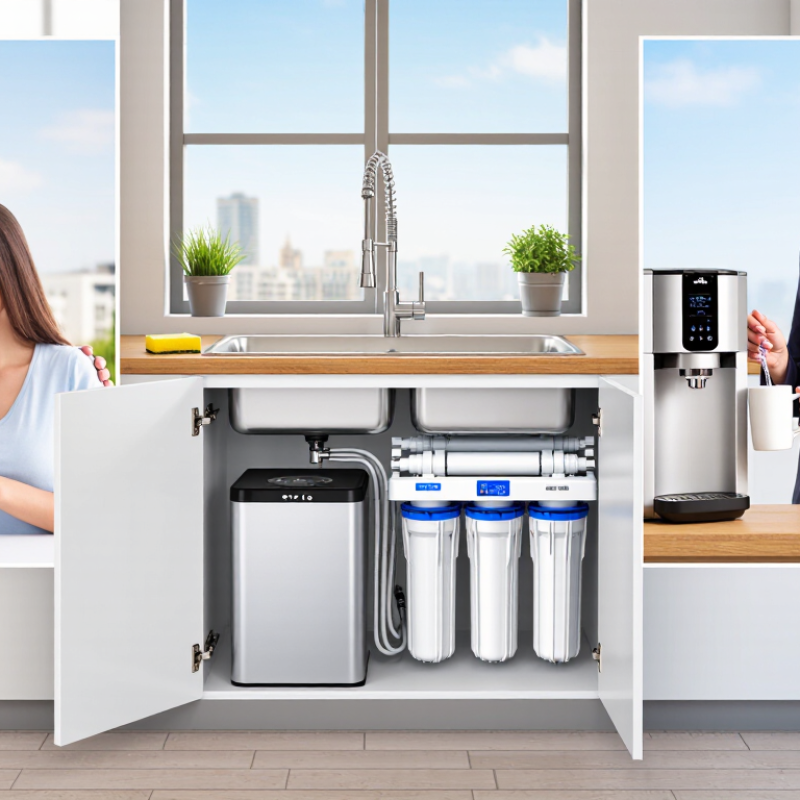
Storage matters during morning peaks. A 3.2-gallon tank may provide less usable water, so check its rated drawdown and the system’s daily production. Look for independent certification to NSF/ANSI 58, which covers RO performance and specific reduction claims. Certification does not mean every contaminant is removed. Check the listing. For upkeep, compare replacement-filter costs and intervals, and leave room under the sink for service. I still think buyers can overvalue long contaminant lists and overlook whether routine maintenance is practical.
Tips: Measure the cabinet space, including tank width and clearance for a filter wrench. Ask for recovery, certified claims, usable storage, and replacement intervals in writing. Match capacity to peak use, not just average demand.
This content is restricted to site members. If you are an existing user, please log in. New users may register … LEARN MORE “Lighting Power & Control-Signal Cable”
We are here to help. You can contact us or create an account online to have access to special products, technical specifications and our new online quote tool.
ELECTRO CABLES
9 Riverside Drive
P.O. Box 276
Trenton, Ontario
CANADA K8V 5R5
N.A. Toll Free: 888-ELECTRO
(1-888-353-2876)
World: 613-394-4896
Fax: 613-394-4101
Email: sale@machinecables.com
We manufacture cables that are certified by the Canadian Standards Association (CSA), listed by Underwriters Laboratories and/or listed by Intertek (ETL).
Our quality management system is registered to ISO 9001: 2015. Our team is dedicated to consistently providing quality service and products to our customers.
© 2025 ELECTRO CABLES • SITE BY SNAP 360•