A partner you can trust
Feed production is a large, competitive business, and small process improvements can matter. Alltech’s 2024 Agri-Food Outlook estimated global feed production at 1.29 billion metric tons in 2023, drawing on information from 142 countries. It is an industry estimate, not a complete census. Still, it shows the scale of demand behind decisions about efficient, consistent manufacturing.
A Feed Pellet Mill can turn conditioned mash into compact pellets that are easier to store, transport, and handle. For operators, that may mean less ingredient separation during handling and more uniform portions at the feeder. The results depend on the full process, not the machine alone. Grind size, moisture, steam conditioning, die specifications, and roller settings all influence pellet quality and energy use. A poorly matched die can raise power consumption or produce fragile pellets. That matters.
Choosing a mill is therefore a business decision, not simply an equipment purchase. Buyers should compare capacity against realistic daily demand, review maintenance access, and ask how output changes across feed formulas. Request measurable performance data, such as throughput, energy use per ton, and pellet durability under stated conditions. Check the assumptions behind every figure. Results from one plant may not transfer neatly to another. A mill can improve production, but it cannot fix every formulation or management problem. That part deserves honest attention.
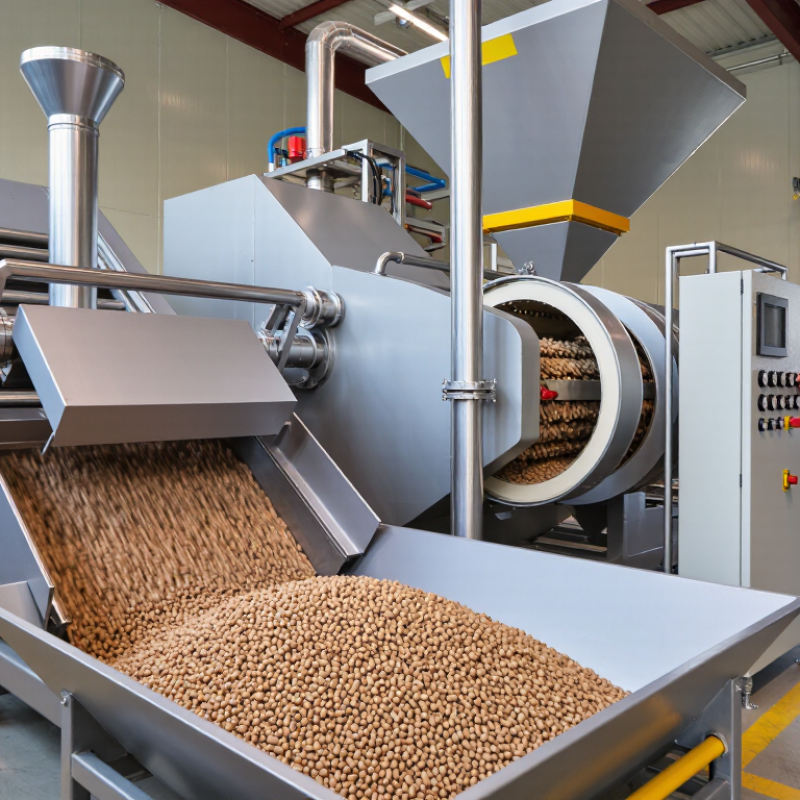
A feed pellet mill converts prepared mash into compact, uniform feed pellets. A typical line includes grinding, batching, mixing, conditioning, pressing, cooling, and screening. During conditioning, steam and moisture soften the mash, helping it bind as it passes through a die. Rollers press the material through small openings, and rotating knives cut the emerging strands to length. The pellets then cool and dry before storage or delivery. Small details matter.
Alltech’s 2024 Agri-Food Outlook estimated that global feed production reached 1.29 billion metric tons in 2023, based on its survey across 142 countries. That figure covers manufactured feed overall, not pellet production alone, but it shows the scale of the industry a mill may serve.
In practice, operators adjust moisture, temperature, die size, and throughput to suit the recipe and equipment. A pellet that looks firm can still crumble during handling. Too much heat may also affect heat-sensitive ingredients. These trade-offs are easy to underestimate.
Reliable operation therefore depends on routine checks, recorded process settings, and testing finished pellets—not appearance alone.

A feed pellet mill compresses ground ingredients into dense, uniform pieces. Heat and moisture condition the mash, helping bind particles and reduce dust. That matters during loading. Pellets are easier to move through bins and augers, and animals can pick them up with less sorting. Fewer loose fines may also mean less feed scattered beneath troughs. Small gains add up.
Behnke’s 1994 Kansas State University feed-manufacturing review reported about 8% better feed efficiency in poultry fed pellets. It also reported 12% greater weight gain, though responses vary with diet and processing conditions. These are historical trial averages, not promises for every operation. Pellet quality still needs checking. Crumbly pellets can break into fines during transport, partly undoing the handling benefit. Operators can monitor pellet durability and inspect samples after conveying, not just at the mill outlet. A glossy, hard pellet is not automatically a better one. Conditioning temperature, moisture, ingredient mix, and die settings all matter. The process can help, but it cannot repair an unbalanced formula. Teams may also overlook the extra energy and maintenance required to run the mill. That trade-off deserves attention.
Feed pellet production can help a farm or feed business handle ingredients more consistently. A mill compresses measured mash into compact pellets, which are easier to store, scoop, and transport. Less dust may also mean cleaner bins and fewer fines around feeders. Those small savings can matter when staff handle many bags each week. Pellet size and durability influence whether animals can eat the ration comfortably, so match settings to species and age.
Producing pellets in-house may reduce dependence on purchased finished feed and give operators more control over formulas. It can also support predictable production schedules, especially when ingredient supply is steady. But a mill needs power, routine die and roller checks, and time for cleaning. Poor conditioning or an unsuitable formula can create brittle pellets, extra fines, or uneven intake. The economics are not automatic; compare energy, labor, maintenance, and ingredient costs against actual output. Even experienced operators may need a few adjustments.
Tips: Test one batch. Check pellet durability and fines after cooling, then record moisture, throughput, and energy use. Change one setting at a time. A small trial can reveal problems before production scales up.
A suitable feed pellet mill should match your daily production target and the ingredients you actually use. Small farms may value easy adjustment, while larger operations often need steady output across long shifts. Treat rated capacity as a guide; moisture, fiber, and particle size can change real throughput. Numbers need context. Ask for a trial using your own feed mix, if possible.
Check the die and roller setup before comparing prices. Die-hole diameter and compression affect pellet size, density, and the force needed to form pellets. High-fiber forage may need a different setup from finely ground grain. Too much compression can increase heat and wear; too little may produce weak pellets. Small details matter. Confirm that dies, rollers, bearings, and belts are available and practical to replace.
Compare motor power, electrical supply, guarding, and dust control with your site conditions. Ask operators to inspect access doors and cleaning points, not just the machine’s exterior. Cleaning time can affect daily output more than expected. A neat capacity estimate can still mislead; feed batches are rarely identical. Request performance data for similar ingredients, and check what maintenance is required during routine operation. Noise, spare-part lead times, and the skill needed for adjustments also deserve a place in your decision.
| Selection Factor | What to Compare | Practical Guidance | Why It Matters |
|---|---|---|---|
| Required production capacity | Expected output per hour, operating hours, and planned production growth. | Compare quoted capacity using the same feed formula, pellet diameter, and operating conditions. Ask whether the figure refers to the pellet mill alone or the complete line. | Actual output varies with ingredients, moisture, pellet size, die design, and process settings; motor power alone does not establish production capacity. |
| Pellet size and feed type | Target pellet diameter, animal type, life stage, and feed formulation. | Confirm that suitable dies are available for the required product. Feed pellet diameters commonly vary from a few millimeters to around a centimeter, depending on the application. | Pellet dimensions affect feeding suitability and can influence processing rate and pellet quality. |
| Mill configuration | Flat-die or ring-die design, batch size, intended duty, and available floor space. | Flat-die machines are often used for smaller-scale production, while ring-die machines are commonly selected for higher-throughput commercial production. Confirm suitability with a feed trial. | Machine configuration affects operating scale, maintenance requirements, and how the mill fits into the production line. |
| Raw material preparation | Ingredient particle size, mixing uniformity, moisture, and the need for grinding or conditioning equipment. | Check whether the mill requires a separate grinder, mixer, conditioner, or moisture-control step to process the planned ingredients consistently. | Feed composition and preparation affect pellet formation, throughput, and finished-pellet quality. |
| Die and roller specifications | Die-hole diameter, die thickness, compression ratio, material, and replacement availability. | Ask for die recommendations matched to the feed formula and target pellet. Confirm expected wear, replacement procedures, and the availability of compatible parts. | Die and roller condition directly influence pellet formation and are important routine maintenance items. |
| Conditioning options | Whether the process uses dry conditioning, steam conditioning, or another suitable preparation method. | If steam conditioning is proposed, include the boiler, water treatment, controls, installation, and operating requirements in the evaluation. | Conditioning changes the feed before pelleting and can affect processing performance; the appropriate setup depends on the formula and production goals. |
| Power and site requirements | Motor rating, electrical supply, installation space, ventilation, and dust-management needs. | Verify electrical compatibility and site requirements with a qualified installer. Consider the power needs of the entire line, not just the pellet mill. | A suitable machine must match the facility’s utilities and layout to operate as intended. |
| Maintenance and support | Access to wear parts, maintenance instructions, operator training, and technical service. | Request a maintenance schedule and a list of critical spare parts. Check how routine die, roller, bearing, and drive-system servicing will be handled. | Planned maintenance helps manage wear-related downtime and supports reliable production. |
| Total cost of ownership | Purchase and installation costs, energy use, labor, consumables, maintenance, and expected operating hours. | Compare costs over a defined operating period and use realistic production assumptions. Include upstream and downstream equipment in the calculation. | The purchase price alone does not represent the cost of producing feed over time. |
Why Choose a Feed Pellet Mill for Your Business?
Planning Installation, Operation, and Maintenance
A pellet mill needs more than floor space. Before installation, check the slab, electrical supply, ventilation, dust control, and room to remove the die. Leave clear access around bearings and drive components; cramped layouts make routine service harder. Alltech’s 2024 Agri-Food Outlook estimated global feed production at 1.29 billion metric tons in 2023, based on data from 142 countries. That scale highlights why dependable capacity matters, but national figures cannot predict your local demand.
Plan operation around the feed mix, moisture, and required pellet size. Record motor amperage, production rate, and pellet durability during each shift. These readings help reveal a slipping roller or overloaded drive before output drops. The International Energy Agency’s 2011 analysis estimated that motor-driven systems use about 45% of global electricity. Though broad and dated, the figure is a useful reminder to track energy use per tonne, not just hourly output. Small details matter.
For maintenance, inspect die holes, roller surfaces, belts, and lubrication points on a set schedule. Keep spare wear parts available, and log replacements with operating hours. Follow the equipment manual for shutdown and isolation procedures before clearing blockages. Not always easy. Dust, rushed shifts, and inconsistent records can undo a good maintenance plan; even one missed inspection deserves a second look.
This content is restricted to site members. If you are an existing user, please log in. New users may register … LEARN MORE “Lighting Power & Control-Signal Cable”
We are here to help. You can contact us or create an account online to have access to special products, technical specifications and our new online quote tool.
ELECTRO CABLES
9 Riverside Drive
P.O. Box 276
Trenton, Ontario
CANADA K8V 5R5
N.A. Toll Free: 888-ELECTRO
(1-888-353-2876)
World: 613-394-4896
Fax: 613-394-4101
Email: sale@machinecables.com
We manufacture cables that are certified by the Canadian Standards Association (CSA), listed by Underwriters Laboratories and/or listed by Intertek (ETL).
Our quality management system is registered to ISO 9001: 2015. Our team is dedicated to consistently providing quality service and products to our customers.

© 2025 ELECTRO CABLES • SITE BY SNAP 360•