How to Choose the Best Micro Coaxial Cable for Your Needs?
Choosing the right micro coaxial cable can be challenging. It’s crucial for ensuring optimal performance in your devices. Micro coaxial cables are used in various applications, including telecommunications, medical devices, and consumer electronics. The right choice affects signal integrity and reliability.
When selecting your micro coaxial cable, consider key specifications. Factors like impedance, diameter, and shielding types play a significant role. You may face difficulty if you overlook these aspects. Comprehensive research is essential for making an informed decision. Different devices may require different features in a cable.
Engaging with experts or manufacturers increases your understanding. Their insights can guide you toward the most suitable option. Pay attention to user reviews and technical details. A well-chosen micro coaxial cable enhances device performance significantly. However, it’s easy to get lost in the details. Thus, take your time and assess your needs carefully.
Understanding Micro Coaxial Cables: Definition and Applications
Micro coaxial cables are essential components in many electronic devices. They are engineered to transmit
high-frequency signals with minimal interference. Common applications include telecommunications, home entertainment, and medical devices.
Understanding their design can help in making informed choices.
These cables consist of a core conductor, insulation, and a shielding layer. The shield protects against
electromagnetic interference, ensuring signal integrity. The micro aspect refers to their small size, which allows
for flexibility in tight spaces. This design is critical in devices where space is limited.
Choosing the right micro coaxial cable depends on specific needs. Consider the frequency range, signal loss, and installation environment.
Each use case may require different specifications. A poor choice can lead to degraded performance. Reflecting on past projects
can provide insights into what works best.
Key Factors to Consider When Choosing Micro Coaxial Cables
When selecting micro coaxial cables, several key factors come into play. The frequency range is critical. Studies show that frequencies above 10 GHz require specialized cabling to maintain signal integrity. Depending on your application—like telecommunications or broadcasting—you may need cables designed for specific frequency ranges.
Signal loss should also be considered. According to a 2022 industry report, a quality micro coaxial cable can exhibit as little as 0.5 dB per 100 meters at high frequencies. Choosing a cable with low attenuation is vital for long-distance runs. Also, check the cable's construction. Shielding options such as foil or braided shields can protect against electromagnetic interference, a common issue in densely populated environments.
Lastly, flexibility and bend radius matter. A cable that is too stiff can be challenging to work with in tight spaces. While it may seem trivial, the geometry can affect installation efficiency. Reflecting on these elements can lead to better decision-making, ensuring that the chosen micro coaxial cable aligns with your specific needs and application requirements. Balancing performance with practical use is essential in your selection process.
How to Choose the Best Micro Coaxial Cable for Your Needs? - Key Factors to Consider When Choosing Micro Coaxial Cables
| Factor |
Description |
Recommended Value |
| Cable Length |
The distance between connection points. |
1 m - 10 m |
| Cable Impedance |
Impedance must match the application requirements. |
50 Ohm or 75 Ohm |
| Frequency Range |
The operational bandwidth for the cable. |
DC to 6 GHz |
| Connector Type |
Type of connectors at both ends of the cable. |
U.FL, SMA, or RP-SMA |
| Shielding |
Level of protection from signal interference. |
Double shielded (braid + foil) |
| Flexibility |
Ability to bend without damaging the cable. |
High flexibility |
| Temperature Range |
Operating temperature for optimal performance. |
-40°C to +85°C |
| Environmental Rating |
Protection against environmental factors. |
IP67 rated |
Comparing Different Types of Micro Coaxial Cables
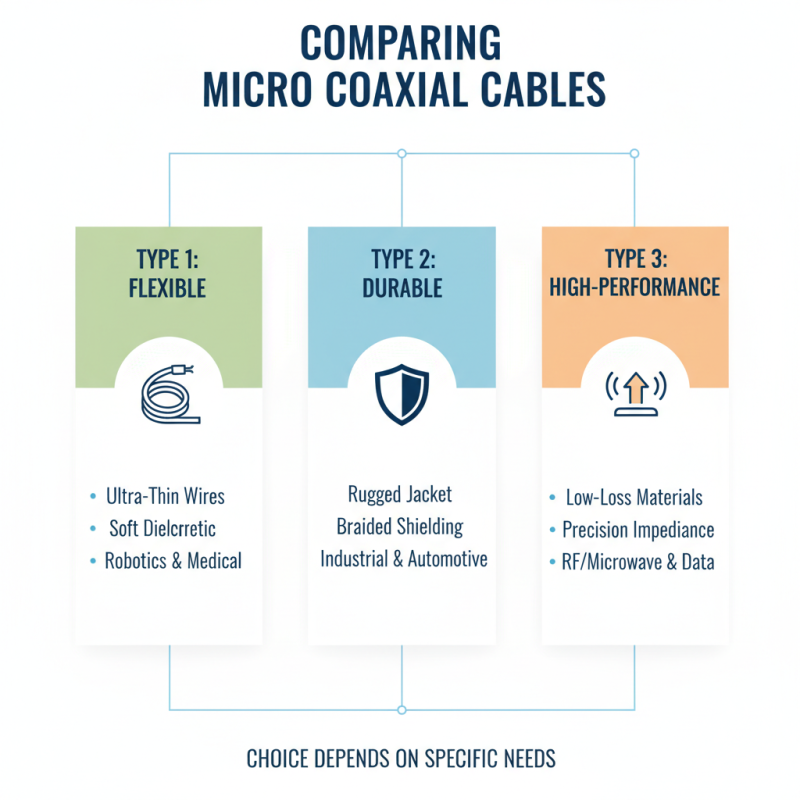
When comparing different types of micro coaxial cables, it's essential to understand their unique characteristics. Micro coaxial cables come in various designs and materials, impacting performance and applications. For instance, some cables focus on flexibility, while others prioritize durability. This variation means that the right choice depends on your specific needs.
Consider the cable's inner conductor and dielectric material. Copper conductors provide excellent conductivity but may lack flexibility. On the other hand, certain alloys can offer both flexibility and adequate performance. The dielectric material also plays a crucial role in attenuation. A low-loss dielectric can significantly enhance signal quality over long distances.
Each type of micro coaxial cable has strengths and weaknesses. It’s vital to reflect on your requirements. Do you prioritize signal integrity or flexibility? Analyzing your application can lead to a more informed decision. Testing different cables in real scenarios can reveal these nuanced performances. Through this experimentation, you may find unexpected challenges that guide you toward the best solution, shaping your understanding of micro coaxial cables.
Tips for Evaluating Cable Specifications and Performance
Choosing the right micro coaxial cable can significantly impact your project's performance. Evaluating specifications is crucial. Firstly, look at the cable's impedance. Most applications benefit from a standard 75 ohms. Deviating from this can lead to signal loss and interference.
Next, consider the attenuation rate. This metric indicates how much signal strength is lost over distance. For instance, a cable with 1 dB/100ft at 500 MHz is more efficient than one with a 3 dB rating. Less attenuation means clearer signals, especially for high-frequency applications. Industry studies indicate that a reduction in attenuation can improve data integrity by 20%.
Also, pay attention to the cable's outer diameter. Thinner cables can be more flexible but may not always handle high stress or mechanical strain well. Too much bending could impair performance, a fact often overlooked. Look for cables that balance flexibility without sacrificing durability. Understanding these specifications will empower you to make an informed decision tailored to your specific needs.
Assessing Cost vs. Quality in Micro Coaxial Cable Selection
When selecting micro coaxial cables, the balance of cost versus quality is crucial. High-quality cables often come with a higher price. They are designed to provide better signal integrity and durability. However, the cost may not always reflect the best option for your specific needs.
Consider the specific application. Will the cable be used in a high-frequency environment? If so, investing in a premium cable is advisable. In other cases, a mid-range product might suffice. Be wary of extremely low-priced options. They often compromise performance and reliability.
Evaluate the materials used in the construction. Quality connectors and insulation can impact overall performance. A poor connection can lead to signal loss. Research user reviews and expert opinions to gauge long-term reliability. This step is essential for informed decisions. It's important to reflect on what features matter most to you.