
A partner you can trust
Choosing the right Virtual Architectural Rendering service can shape how clients understand, trust, and remember a project. A polished image is useful, but it cannot repair unclear design decisions, missing measurements, or weak communication. The strongest providers begin with your drawings, materials, lighting goals, and audience. They ask practical questions before opening their software.
Ronen Bekerman, an architectural visualization artist and educator, has stated, “The image should serve the architecture, not replace it.” This principle deserves attention. A reliable studio should translate the architect’s intention into believable spaces, not add dramatic effects without purpose. Review its portfolio carefully. Look for accurate scale, convincing textures, natural shadows, and human activity that feels restrained. Request a sample workflow, including modeling, revisions, camera approval, and final delivery. Ask who owns the source files. Confirm deadlines, image sizes, software compatibility, and revision limits in writing.
Details reveal experience. Can the team match a stone finish under changing daylight? Can it show a narrow corridor without making it look oversized? Can it revise a balcony after a late structural update? These moments matter more than a beautiful homepage.
No provider is perfect. I have seen impressive visuals hide vague processes. I have also seen modest portfolios deliver excellent collaboration. Compare communication quality, technical discipline, and design sensitivity together. The cheapest quote may become expensive after repeated corrections. Choose a service that explains its decisions, protects your information, and welcomes reasonable critique. Your final image should feel persuasive, precise, and honest. Sometimes, less spectacle works better.
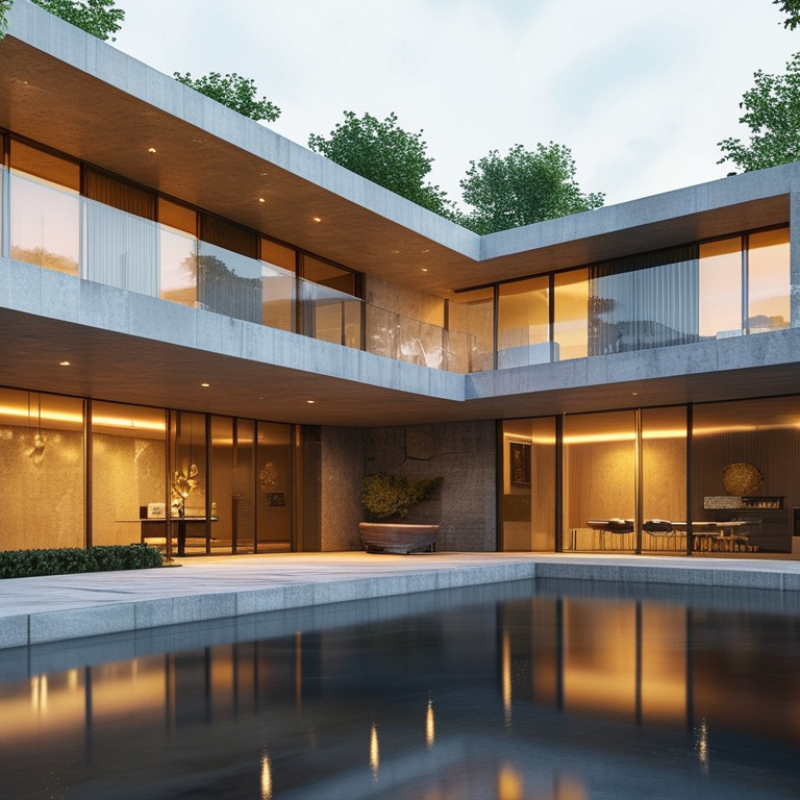
Before requesting virtual architectural rendering services, define what the images must accomplish. A marketing hero image needs a different treatment from a planning presentation. Record the project type, target audience, viewing distance, and required delivery date.
Describe each camera position with practical detail. For example, specify a street-level view, a two-story perspective, or an interior angle facing the kitchen island. Share drawings, site photographs, dimensions, material samples, and landscape plans. Note the season, time of day, weather, and lighting mood. Small choices affect credibility.
Decide how accurate the model must be. A concept image may accept simplified furniture, while a planning submission needs dependable massing, access routes, and neighboring context. Confirm file formats, image sizes, animation needs, revision limits, and approval stages. Ask who checks dimensions and material colors before final delivery.
I have seen projects lose time because “realistic” meant different things to different people. Clarify that word. A reliable brief should also identify uncertain details, such as unfinished planting or pending façade materials. Mark them clearly instead of hiding them. That honesty helps the rendering team make informed assumptions and prevents attractive images from creating misleading expectations.
Keep one shared reference folder. Label every file with its date and status. Useful details matter.

Output resolution is one of the first requirements to define when selecting a virtual architectural rendering service. Web previews typically need fewer pixels, while large-format print requires substantially higher resolution. The figures below are calculated from common display dimensions and 300 DPI print dimensions.
Choosing virtual architectural rendering services requires more than comparing attractive sample images. Review the team’s architectural experience, not only its software skills. Ask whether artists understand floor plans, material behavior, daylight direction, and construction constraints. A 2023 digital construction report found that 69% of professionals identified improved coordination as a major BIM benefit. Providers should therefore explain how they check models before rendering. Request a sample based on your own drawings.
Style comparison needs structure. Examine daylight softness, camera height, color temperature, landscaping, and furniture scale. A useful provider can reproduce a defined visual language across interior and exterior scenes. They should also show revisions, not just polished final images. This reveals communication habits. Sometimes the most beautiful image is technically wrong.
Technical capability affects approval speed and future use. Ask about 4K output, panoramic views, animation, file formats, model compatibility, and revision tracking. A 2024 construction technology survey reported that data exchange and interoperability remain significant adoption barriers across project teams. That finding matters when architects, developers, and consultants use different platforms. Test a small paid scene before committing. It may expose weak geometry, slow feedback, or inconsistent lighting. Expertise is useful, but dependable process matters more.
Choosing virtual architectural rendering services requires more than admiring polished images. A portfolio should show complete projects, not only dramatic hero shots. Look for consistent lighting, believable materials, accurate scale, and human details such as fingerprints on glass or uneven landscaping. Ask for comparable residential, commercial, or hospitality work. A beautiful image can still hide weak spatial judgment.
Workflow reveals professional discipline. Request a clear path from brief to draft, revisions, approval, and final delivery. The 2021 Harnessing the Data Advantage in Construction report estimated that poor data costs the industry 14.7% of annual revenue, or about $1.84 trillion worldwide. That figure makes file control and revision tracking practical concerns, not administrative decoration. Confirm naming systems, model compatibility, image resolutions, backup procedures, and who owns the final files. Small omissions become expensive later.
Communication deserves direct testing. Send a short brief with one deliberate ambiguity, then observe the questions you receive. Good teams clarify camera height, material intent, daylight direction, and deadlines before producing anything. The RIBA AI Report 2024 also highlights growing concerns around verification, authorship, and professional accountability. Ask how visual changes are recorded and approved. Slow replies are not always a failure, but vague replies usually are. I would also request a paid test frame. It may feel inefficient. Yet one test can expose weak interpretation, excessive retouching, or a workflow that depends on guesswork.
Choosing virtual architectural rendering services requires more than comparing a low quote. Ask whether pricing is fixed per view, hourly, or package-based. Confirm what modeling, lighting, landscaping, post-production, and source files include.
Grand View Research projected a 22.5% compound annual growth rate for the 3D rendering and visualization market from 2023 to 2030.
Rising demand can increase workload, but it should not excuse unclear fees.
Request a timeline with approval points. A simple exterior image may take several business days, while a detailed interior scene can require multiple weeks. Specify when the clock starts. Late delivery often begins with missing drawings, not slow artists.
PMI’s Pulse of the Profession 2021 reported that organizations wasted 9.4% of investment because of poor project performance. That figure supports written milestones, named reviewers, and prompt feedback.
My own practical warning is less polished: “Fast” is meaningless without a defined image count.
Revisions need boundaries. Two review rounds may be reasonable, but changing the camera angle can require substantial rebuilding. Ask whether revisions cover color, materials, and furniture only. Confirm extra rates before work begins.
Final deliverables should list resolution, file format, aspect ratio, color profile, ownership terms, and delivery method. Request a full-resolution file, a web version, and editable source assets when appropriate.
A small missing item, such as a layered file, can become expensive later.
Market reports measure growth; they do not measure communication quality. That remains the client’s responsibility to test.
Choosing a virtual architectural rendering service is only half the decision. The project terms shape the final result.
Start by reviewing comparable portfolios, not only polished hero images. Ask for a sample scene, production timeline, and quality-control checklist. Confirm who checks lighting, scale, materials, camera angles, and model accuracy. The FMI and Autodesk 2021 report estimated that poor data and communication cost the United States construction industry $177.5 billion annually. Clear visual information can reduce expensive misunderstandings. That matters.
Define the deliverables in writing. Specify image dimensions, animation length, file formats, level of detail, viewpoints, and revision limits. Include milestones for draft approval, material confirmation, and final export. State whether the service supplies editable models, source files, or only rendered images. Confirm intellectual-property ownership, confidentiality, payment stages, and cancellation terms. Be specific. Vague wording creates friction later.
A realistic schedule should include review time. McKinsey’s 2017 construction productivity report found annual construction productivity growth near 1%, compared with 2.8% across the global economy. Delays often begin with unclear decisions, not slow rendering. In my experience, a convincing test image reveals more than a long sales presentation. Still, one successful test cannot prove every capability. Ask for professional references and documented revisions. Check file naming, version control, and backup procedures. Nothing is perfect. Leave room for correction, because design intent can change after the first visual review.
| Evaluation Dimension | Typical Options or Benchmark | What to Confirm Before Selection | Recommended Project Term |
|---|---|---|---|
| Primary Deliverable | Exterior still, interior still, aerial view, animation, 360° panorama, or interactive model | Number of views, camera positions, output format, resolution, aspect ratio, and intended use | List every deliverable in a numbered schedule attached to the agreement |
| Image Resolution | Web images commonly use approximately 1,920 × 1,080 pixels; print and large-format applications require higher resolution | Whether the quoted price covers final-resolution files or only previews | Specify pixel dimensions, file type, color profile, and compression requirements |
| Source Materials | CAD drawings, BIM models, plans, elevations, material schedules, site photographs, and design references | Accepted software versions, model cleanliness, missing information, and responsibility for corrections | Define the document issue date and treat later design changes as new inputs |
| Visual Style | Photorealistic, illustrative, minimalist, atmospheric, diagrammatic, or competition-style | Reference images, lighting mood, season, weather, landscaping density, people, vehicles, and furniture direction | Include a visual reference board and define which creative decisions require approval |
| Project Complexity | Low: simple massing; medium: furnished or landscaped scenes; high: detailed materials, crowds, complex lighting, or animation | Geometry detail, custom modeling, entourage requirements, number of materials, and environmental context | Use a scope matrix separating included modeling from optional custom work |
| Turnaround Time | A single still often requires several business days; animation and multiple views generally require substantially longer schedules | Whether timing begins after receipt of complete files and whether review time is included | Set milestone dates for briefing, draft, comments, revision, and final delivery |
| Review Stages | Brief confirmation, clay or massing preview, materials and lighting preview, then final rendering | Preview quality, annotation method, response time, and who has final approval authority | Require written approval at each stage before progressing |
| Revision Allowance | A defined number of revision rounds is more predictable than unlimited revisions | What counts as a minor correction, major change, additional view, or new design direction | State the included rounds and provide an hourly or per-change rate for extras |
| Pricing Structure | Per image, per animation minute, per panorama, fixed project fee, or time-based billing | Included services, taxes, asset purchases, rush fees, rendering costs, and post-production limits | Request an itemized quotation with assumptions, exclusions, and payment milestones |
| Communication | Email, scheduled video meetings, shared review platform, or annotated PDF/image feedback | Time-zone coverage, primary contact, response target, file-sharing method, and meeting frequency | Nominate one decision-maker and consolidate feedback into one written response |
| Ownership and Usage Rights | Usage may cover marketing, planning submissions, presentations, competitions, websites, or social media | Who owns the source scene, custom models, textures, final images, and future-edit rights | Define license scope, territory, duration, portfolio permission, and confidentiality requirements |
| Quality Control | Checks should cover geometry, materials, lighting, composition, image artifacts, spelling, and file integrity | Correction period after delivery and procedure for reporting technical defects | Allow a defined post-delivery correction window for errors against the approved brief |
| Change Control | Design changes after approval can affect cost, schedule, camera composition, modeling, and rendering time | Approval process, written variation quotation, schedule impact, and authorization threshold | No out-of-scope work begins without written approval of the variation |
Note: Timeframes, revision limits, and pricing methods vary according to project scope, source-file quality, detail level, location, and final-use requirements. Use the table as a comparison checklist rather than a fixed quotation.
This content is restricted to site members. If you are an existing user, please log in. New users may register … LEARN MORE “Lighting Power & Control-Signal Cable”
We are here to help. You can contact us or create an account online to have access to special products, technical specifications and our new online quote tool.
ELECTRO CABLES
9 Riverside Drive
P.O. Box 276
Trenton, Ontario
CANADA K8V 5R5
N.A. Toll Free: 888-ELECTRO
(1-888-353-2876)
World: 613-394-4896
Fax: 613-394-4101
Email: sale@machinecables.com
We manufacture cables that are certified by the Canadian Standards Association (CSA), listed by Underwriters Laboratories and/or listed by Intertek (ETL).
Our quality management system is registered to ISO 9001: 2015. Our team is dedicated to consistently providing quality service and products to our customers.

© 2025 ELECTRO CABLES • SITE BY SNAP 360•