A partner you can trust
Choosing the right Micron Pleated Filter Cartridge requires more than selecting the smallest micron rating. It demands a clear understanding of the fluid, equipment, and operating conditions. A cartridge marked “1 micron” may use nominal or absolute performance ratings. These ratings are not interchangeable. Always check the test method and supporting data. It is a small detail. It can change the result significantly.
Start by identifying the contaminant size, concentration, and physical behavior. Record the required flow rate, pressure, temperature, and acceptable pressure drop. A filter with tighter media may capture more particles, but it can also load faster. That trade-off matters. Field experience shows that oversized cartridges often provide steadier service and longer replacement intervals. However, excessive capacity may increase purchase and housing costs. The best choice balances protection, efficiency, and practical maintenance.
Material compatibility deserves equal attention. Confirm that the membrane, support layer, seals, and end caps suit the process fluid. Consider polypropylene, polyester, or other media only after reviewing chemical resistance data. Check cartridge length, connection style, and housing capacity before ordering. A perfect filter on paper may fail when its gasket swells or its flow path restricts the pump. That is easy to overlook. Reliable selection also depends on manufacturer documentation, traceable quality testing, and clearly stated replacement criteria. No choice is flawless. Reviewing real operating results can reveal assumptions that product brochures do not show.
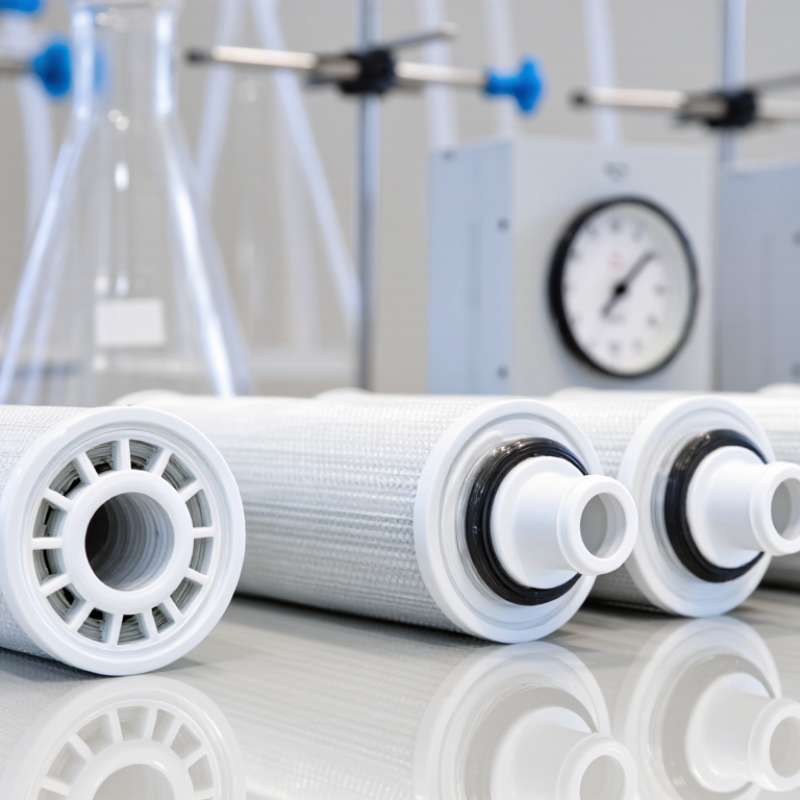
Choosing the right micron pleated filter cartridge starts with understanding its rating. A micron, or micrometer, equals one-millionth of a meter. Ratings from 0.1 to 100 µm describe particle size, but they do not guarantee identical performance. Nominal filtration removes a stated percentage of particles at or above the rated size under defined conditions. A 10 µm nominal cartridge may reduce most 10 µm particles while allowing smaller particles through. Ask for the test percentage.
Absolute filtration is stricter. It usually indicates that nearly all particles at the rated size are retained during a specified challenge test. However, “absolute” is not a universal guarantee. Test methods, particle shapes, pressure, flow, and fluid viscosity can change results. In field work, I have seen a 1 µm cartridge perform differently during high-flow operation. The label was accurate, but the application was poorly matched. Compare the test standard, beta ratio, dirt-holding capacity, pressure drop, and fluid compatibility. A 0.1 µm rating may be unnecessary for large sediment. A 100 µm cartridge may protect downstream equipment while preserving flow.
Tips: Match the rating to the smallest harmful particle, not the smallest visible particle. Confirm whether the rating is nominal or absolute. Request supporting test data. Check the initial pressure drop at your actual flow rate. Leave safety margin for temperature changes and particle loading. Do not assume tighter filtration is always better; it may shorten service life and increase energy use. Recheck the choice after installation. Real systems rarely behave exactly like laboratory tests.
| Nominal Micron Rating | Typical Absolute Rating Range* | Particle Size Target | Typical Filtration Objective | Suitable Applications | Selection Guidance |
|---|---|---|---|---|---|
| 0.1 µm | Approximately 0.1–0.2 µm | Very fine particles, colloids, and some bacteria-sized contaminants | High-grade particulate reduction and fine polishing | Critical process water, laboratory fluids, and final polishing stages | Use only when the process can tolerate higher pressure drop and lower dirt-loading capacity. |
| 0.2 µm | Approximately 0.2–0.4 µm | Submicron particles and fine microbial-sized contaminants | Fine clarification before sensitive process steps | Pharmaceutical and laboratory process fluids, where validated performance is required | Confirm compatibility, sterilization requirements, and validated retention data. |
| 0.45 µm | Approximately 0.45–0.8 µm | Fine suspended solids and many bacteria-sized particles | Fine clarification and analytical sample preparation | Laboratory samples, water analysis, and final-stage liquid clarification | A common fine-filtration choice; do not assume sterilizing-grade performance without validation. |
| 1 µm | Approximately 1–2 µm | Fine silt, rust fines, and small suspended particles | Fine polishing with moderate flow resistance | High-purity water, chemicals, coatings, and hydraulic protection | Choose absolute-rated media when downstream equipment has tight particle limits. |
| 3 µm | Approximately 3–6 µm | Fine sand, silt, and process debris | General fine filtration and equipment protection | Industrial water, coolants, inks, and low-viscosity chemicals | A practical balance between particle control, service life, and flow rate. |
| 5 µm | Approximately 5–10 µm | Visible fine sediment and small rust particles | Standard particulate removal | Pre-filtration, drinking-water treatment stages, and general process liquids | Often used as a final filter when moderate clarity is required without excessive pressure loss. |
| 10 µm | Approximately 10–20 µm | Coarse silt, sand, and larger suspended solids | General-purpose pre-filtration | Process-water protection, irrigation water, and upstream protection for finer cartridges | A good first-stage selection when the feed contains moderate suspended solids. |
| 25 µm | Approximately 25–50 µm | Coarse sediment, flakes, and larger rust particles | Bulk solids reduction and protection of downstream filters | Industrial water, cooling systems, wash water, and pre-filtration | Use when high dirt-holding capacity and low operating pressure drop are priorities. |
| 50 µm | Approximately 50–100 µm | Large sand, scale, fibers, and visible debris | Coarse screening and equipment protection | Raw-water pre-treatment, cooling-water loops, and pump protection | Consider a reusable strainer or backwashable pre-filter when solids loading is high. |
| 100 µm | Approximately 100–200 µm | Large particles, coarse sand, scale, and process debris | Coarse pre-filtration and protection of pumps or finer filters | Raw water, industrial utility water, and heavily contaminated feed streams | Use as the first filtration stage; it is not intended for fine clarification. |

Choosing a micron pleated filter cartridge requires more than reading its pore-size label. In field inspections, I compare the Beta ratio with flow rate, fluid viscosity, and pressure-drop data. A filter marked “5 micron” may describe nominal performance, not consistent particle removal.
The Beta ratio shows how many particles enter compared with how many pass through. For example, β5 ≥ 1000 means that, for particles sized 5 microns or larger, only one particle may pass for every 1,000 entering.
The calculated removal efficiency is 99.9% under the stated test conditions. The number matters. However, test conditions can differ from real operation.
A cartridge with β5 ≥ 1000 may protect sensitive equipment, but it can also create higher initial pressure drop. Dirt loading, temperature changes, and thick fluids can reduce practical flow. I have seen systems selected by efficiency alone, then opened later with collapsed pleats or frequent replacement needs.
That shortcut is costly. Check the manufacturer’s test standard, differential-pressure limit, and dirt-holding capacity before approval.
Do not stop there. Compare actual operating data with the laboratory rating, because a perfect specification can still be the wrong filter for the system.
How to Choose the Right Micron Pleated Filter Cartridge
Choosing a micron pleated filter cartridge requires more than selecting a nominal micron rating. In field testing, operators often compare cartridges by flow alone. That can be misleading. A 5-micron cartridge may pass less water than expected when viscosity rises. Flow capacity depends on media area, housing design, fluid temperature, and contaminant loading. Start with actual operating flow, not a catalogue maximum.
Record inlet and outlet pressure during normal operation. Calculate the differential pressure, or ΔP, across the cartridge. A clean cartridge should have a documented starting ΔP at the target flow. As particles collect, pressure drop increases. Replace the cartridge at 0.7 bar ΔP, unless a validated process limit requires earlier action. This threshold helps protect flow stability and reduces the risk of media damage or bypass. Do not reset the gauge casually. Small errors matter.
Keep a simple log with the date, fluid temperature, flow rate, inlet pressure, outlet pressure, and service hours. If ΔP reaches 0.7 bar unusually quickly, investigate upstream solids, incorrect micron selection, or insufficient filter area. I have seen teams blame the cartridge first; sometimes the pump was oversized. That lesson is easy to miss. Verify readings with calibrated instruments and inspect removed cartridges for uneven loading, tears, or channeling. A cartridge can look clean externally while its pores are loaded. Review the replacement interval after several cycles, not after one convenient result.
Match flow capacity with pressure drop and replace the cartridge when differential pressure reaches 0.7 bar.
Reference profile: Clean-water flow through a typical 10-inch, 5-micron pleated filter cartridge. Actual performance varies with cartridge geometry, fluid viscosity, temperature, and contaminant loading. At approximately 35 L/min, the differential pressure reaches the 0.7 bar replacement guideline.
A cartridge rated for pH 2–13 is not automatically safe across that range. Confirm the membrane, support layer, cage, core, and seal material separately. Polypropylene can suit many aqueous processes, while fluoropolymer media may offer stronger resistance to aggressive chemicals. However, temperature changes the result. At 121°C, pressure, steam, and repeated cycles can cause shrinkage or seal relaxation. Check the manufacturer’s immersion, pressure, and sterilization data.
The WHO Guidelines for Drinking-water Quality, incorporating the 2022 addendum, notes that treated water commonly operates around pH 6.5–8.5. Industrial cleaning may extend far beyond that range. Test the actual cleaning chemical, concentration, exposure time, and temperature. ASTM F838-20 uses Brevundimonas diminuta at a challenge level of approximately 10⁷ organisms per square centimetre of effective filter area. This shows why pore ratings alone cannot prove retention performance.
Seal selection deserves equal attention. Silicone may tolerate broad temperatures, while EPDM often suits hot water and alkaline cleaning. Fluoroelastomers can perform well with many chemicals, but compatibility still depends on the exact formulation. I have seen charts look reassuring, then fail after repeated heat cycles. That is the uncomfortable part. Request extractables data, dimensional-change results, and validated test conditions. A small trial at pH 2, pH 13, 2°C, and 121°C can reveal weaknesses before full installation.
Choosing a micron pleated filter cartridge for sterile service starts with the process, not the catalog number. A 0.22 µm membrane is commonly selected for sterilizing-grade liquid filtration, but pore size alone does not prove sterility. Fluid viscosity, temperature, surface tension, and chemical compatibility affect flow and retention. Small details matter. A viscous solution may need a larger filtration area, while a reactive solvent can weaken the membrane or housing. Review throughput, pressure limits, contact materials, and hold time before sizing the cartridge.
Integrity testing is the practical checkpoint. Perform a validated test after installation and, where required, before use or after processing. Common methods include bubble-point, diffusion, and pressure-hold testing. Wet the membrane with the specified fluid, stabilize the system, and control temperature. Otherwise, the reading may drift. Test equipment should have current calibration, and acceptance limits should come from process validation rather than guesswork. Record lot details, test conditions, pressure, time, and operator observations. A passing result supports filter integrity, but it does not replace microbial control, aseptic technique, or a validated sterilization strategy.
In the field, setup errors can look like membrane failures. Trapped air, incorrect flow direction, or a damaged seal may produce confusing results. Inspect gaskets and connections before blaming the cartridge. Challenge the selected filter with the actual product or a justified surrogate, because laboratory water may behave differently. Recheck assumptions when the process changes. A filter that worked yesterday may not fit today’s formulation, temperature, or pressure profile.
This content is restricted to site members. If you are an existing user, please log in. New users may register … LEARN MORE “Lighting Power & Control-Signal Cable”
We are here to help. You can contact us or create an account online to have access to special products, technical specifications and our new online quote tool.
ELECTRO CABLES
9 Riverside Drive
P.O. Box 276
Trenton, Ontario
CANADA K8V 5R5
N.A. Toll Free: 888-ELECTRO
(1-888-353-2876)
World: 613-394-4896
Fax: 613-394-4101
Email: sale@machinecables.com
We manufacture cables that are certified by the Canadian Standards Association (CSA), listed by Underwriters Laboratories and/or listed by Intertek (ETL).
Our quality management system is registered to ISO 9001: 2015. Our team is dedicated to consistently providing quality service and products to our customers.

© 2025 ELECTRO CABLES • SITE BY SNAP 360•