A partner you can trust
Buying a Portable Light Strip for international projects is not simply a matter of choosing bright LEDs. Buyers must balance portability, battery life, color quality, durability, packaging, and supplier reliability. A strip that performs well in a showroom may fail in a humid hotel room or during repeated transport. Small details matter.
This guide shares ten practical buying tips based on common sourcing and product-testing experience. We will examine brightness, color temperature, flexible materials, charging methods, control systems, adhesive strength, waterproof protection, and regional electrical requirements. Check voltage, plug type, battery specifications, and applicable safety markings before placing a large order. Requirements can differ between markets, and supplier claims should be verified through current documentation or independent testing.
Do not trust attractive product photos alone. Request samples, inspect the connectors, measure charging time, and test the strip after several installation cycles. Ask whether the adhesive leaves residue on painted walls. Ask how replacement parts and warranty claims are handled. These questions may feel slow, but they often prevent expensive returns.
There is no perfect model.
A compact strip may offer convenient travel but weaker brightness. A powerful model may need a heavier battery and stronger packaging. Even experienced buyers can overlook heat buildup or unclear instructions. That is why careful comparison remains essential. The following tips are designed to help global buyers make more informed, practical decisions while recognizing that real performance depends on the product, environment, supplier, and intended use.
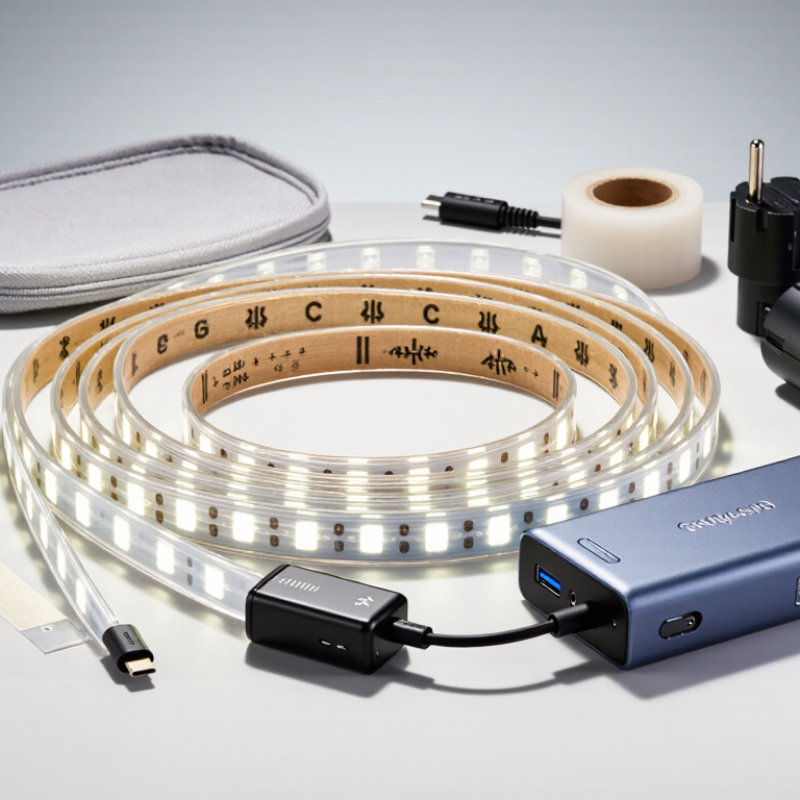
Before comparing brightness or color effects, define the strip’s real job. A camping strip needs low weight, simple battery charging, and soft light for a small tent. A display strip needs stable color, clean cable routing, and reliable adhesion. For emergency lighting, runtime matters more than decorative effects. The U.S. Department of Energy reports that LED products use at least 75% less energy and can last up to 25 times longer than incandescent lighting. That advantage still depends on correct sizing.
Measure the installation surface before buying. Painted walls, fabric, glass, and rough wood require different mounting methods. Dust, heat, and repeated movement can weaken adhesive quickly. I have seen buyers choose powerful strips, then lose useful runtime because the battery was too small. Check voltage, wattage per metre, battery capacity, and expected operating hours together. The IEA’s Energy Efficiency 2023 report identifies lighting as roughly 15% of global electricity use, so efficient operation remains important for portable products.
Match protection to the environment. Under IEC 60529, an IP65 enclosure resists dust and water jets, but it is not designed for immersion. Outdoor users should also consider rain exposure, temperature changes, and connector sealing. Indoor users may prioritise CRI, glare control, and flexible mounting. A strip that looks excellent on a product page may perform poorly on a cold, uneven surface. Test a short section first. That small step can prevent a costly replacement.
Portable light strips vary more than product photos suggest. Flexible SMD strips create visible light points, while COB strips produce a smoother line. Battery-powered models suit shelves, tents, and temporary displays. USB-powered strips are easier to recharge and replace. Check the connector carefully. A poor connection can cause flickering during movement.
Measure the installation area before choosing a length. Leave a small allowance for corners, but avoid tightly folding the strip. Some strips can be cut at marked points; others cannot. I once ordered the exact measured length and regretted it. The cable routing needed extra space. For global buyers, confirm input voltage, charging method, plug style, and controller compatibility. A clear technical datasheet is more reliable than vague phrases like “super bright.”
Brightness should match the task. Around 300 to 600 lumens per meter may suit accent lighting, while work areas need stronger output. Test brightness at the actual distance, not only at the strip surface. Warm white creates a softer room atmosphere, and cool white helps with detailed tasks. RGB offers colorful effects, but it may not produce convincing white light. RGBW adds a dedicated white diode and usually gives better practical color control. Look for a stated color temperature and, when relevant, a color rendering value. Waterproof protection helps outdoors, though seals and connectors still need inspection. More features are not always better. Simpler controls often prove more dependable.
Portable light strips need more than attractive brightness and flexible installation. Global buyers should inspect the power source before comparing designs. A USB model may need a wall adapter, power bank, or vehicle socket. Check voltage, current, connector type, and plug compatibility for the destination market. Small details matter. I have seen a strip fail because its adapter supplied too little current. Reliable sellers should provide clear electrical specifications and safety information.
Tip: Match the battery to the intended working time. A strip used for short outdoor tasks may need only a compact rechargeable battery. Emergency lighting requires a larger capacity and a visible battery indicator. Compare runtime at the brightness level you will actually use. Maximum brightness often shortens battery life sharply. Cold weather can reduce performance. Test it twice before relying on it.
Tip: Examine the charging method carefully. USB-C charging is convenient, but charging speed still depends on the adapter and cable. Look for overcharge, overheating, and short-circuit protection. Energy-efficient LEDs can extend runtime, especially with dimming controls or motion sensors. Measure actual consumption when possible, rather than trusting vague efficiency claims. Some product pages simplify these figures too much. That doubt is useful. Choose replaceable cables, strong connectors, and a battery that can be inspected or changed safely.
When buying a portable light strip, test the controls before admiring its colors. A physical button can help when an app fails. Check dimming steps, timer accuracy, memory after power loss, and smooth brightness changes. Cheap controllers may create visible flicker on camera. Small details matter. The Bluetooth Special Interest Group’s 2024 Market Update projects annual Bluetooth device shipments will reach 7.5 billion by 2028, up from 5.4 billion in 2023. This growth does not guarantee reliable connectivity. Ask about pairing limits, reconnection time, firmware support, and offline operation.
For durability, read the ingress rating under IEC 60529, rather than trusting “waterproof.” IP65 resists dust and water jets, while immersion requires a higher rating. Confirm that protection covers the strip, connectors, battery pack, and remote. Bend a sample gently. Sharp creases can damage internal copper paths. Also inspect adhesive performance on painted walls and fabric. The U.S. Department of Energy’s 2023 solid-state lighting forecast expects LED efficacy to improve through 2035, but efficiency cannot fix weak construction. I have seen efficient strips fail because connectors loosened.
Safety evidence deserves paperwork. Look for testing against IEC 60598-1, relevant battery standards, and the destination market’s conformity requirements. Verify thermal protection, overcharge protection, strain relief, and charger ratings. Do not accept a certificate covering only the LED chips. Check the exact model number. Ask for current documents, not screenshots. My own mistake was trusting a familiar symbol without checking its scope. That shortcut still needs questioning.
Portable light strips can vary widely across regions. Check input voltage, charging method, plug type, connector size, and control frequency before ordering. A strip designed for one market may perform poorly elsewhere. Request test samples with the intended adapter, then run them for several hours. Watch for heat, flicker, weak adhesive, and uneven brightness. Small details matter.
Tip: Ask suppliers for compatibility data, safety test reports, and clear installation instructions. Documents should match the exact model and production batch. Do not rely only on attractive product photos. I have found that sample performance can differ from mass production, so retain a sealed reference sample for comparison.
Supplier reliability needs practical verification. Review response speed, sample consistency, production capacity, packaging quality, and after-sales procedures. Request recent inspection records and a written quality checklist. Compare the full landed price, including packaging, shipping, minimum order quantities, spare parts, and possible regional charges. The lowest quote is rarely the lowest final cost. Allow room for mistakes.
Tip: Put warranty terms in writing. Confirm coverage length, brightness limits, battery conditions, replacement timing, and evidence requirements. Ask how defective units are identified and tracked. A useful warranty process should name responsible contacts and provide batch records. Test a small order first, because trust should be measured, not assumed.
This content is restricted to site members. If you are an existing user, please log in. New users may register … LEARN MORE “Lighting Power & Control-Signal Cable”
We are here to help. You can contact us or create an account online to have access to special products, technical specifications and our new online quote tool.
ELECTRO CABLES
9 Riverside Drive
P.O. Box 276
Trenton, Ontario
CANADA K8V 5R5
N.A. Toll Free: 888-ELECTRO
(1-888-353-2876)
World: 613-394-4896
Fax: 613-394-4101
Email: sale@machinecables.com
We manufacture cables that are certified by the Canadian Standards Association (CSA), listed by Underwriters Laboratories and/or listed by Intertek (ETL).
Our quality management system is registered to ISO 9001: 2015. Our team is dedicated to consistently providing quality service and products to our customers.

© 2025 ELECTRO CABLES • SITE BY SNAP 360•