A partner you can trust
Selecting a manufacturer for API 5L SSAW carbon steel pipe requires more than comparing prices or browsing polished product photos. Buyers need to assess whether a supplier can meet the project’s grade, diameter, wall thickness, and delivery requirements. The right choice depends on the application. A pipeline project and a general structural use may call for different checks.
This 2026 guide introduces manufacturers and the practical questions buyers can use to evaluate them. It considers production capacity, product traceability, inspection procedures, and experience with spiral submerged arc welded pipe. Ask for current certificates and mill test reports, then confirm that the documents match the quoted product and order. Check how the supplier handles weld inspection, dimensional tolerances, coating options, and packing for transport. Details matter.
A company’s marketing claims alone are not proof of consistent quality. Request clear answers about testing methods, production lead times, and how nonconforming material is managed. Where possible, compare responses against the project specification and arrange an independent inspection before shipment. That takes time. It can also reveal gaps that a product brochure will not show.
The manufacturers discussed here are starting points, not a universal ranking. Capabilities, certifications, and availability can change, so verify important information directly before making a purchase decision. Even a careful review has limits. The final supplier choice should reflect documented performance, technical fit, and the needs of the project—not just a prominent name.
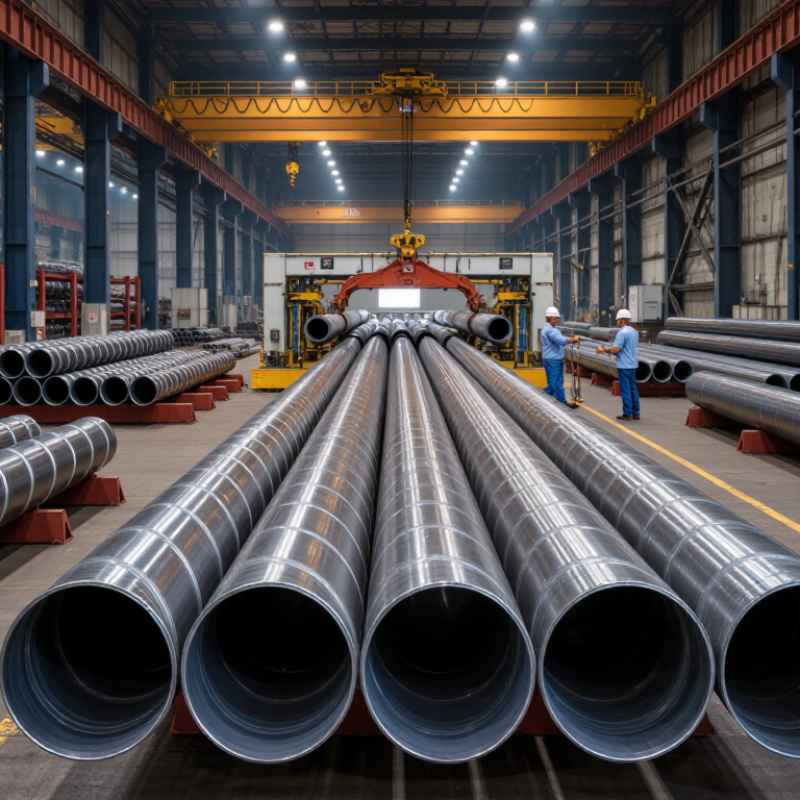
API 5L SSAW pipe is made by forming a steel coil into a spiral shape and welding the seam with submerged arc welding. The helical seam allows large diameters from relatively narrow plate widths. In practice, this supports efficient production for water, oil, and gas transmission lines. However, spiral welding does not remove the need for strict process control. Operators must monitor strip alignment, welding heat, flux condition, and seam penetration.
PSL1 is the basic product specification level. It defines essential requirements for chemical composition, mechanical strength, dimensions, and testing. PSL2 applies tighter controls and usually requires additional verification, including impact toughness testing and stricter limits for chemistry and mechanical properties. Depending on the service environment, buyers may also request ultrasonic inspection, hydrostatic testing, weld repair controls, and traceable mill test documentation. These details matter when pipe enters demanding field conditions.
A reliable manufacturer should show heat numbers, welding records, inspection results, and calibration evidence. Ask how rejected weld sections are isolated. Ask how coating damage is prevented during handling. Small gaps in records can become large problems during installation. One practical lesson is easy to overlook: a certificate alone cannot prove consistent pipe quality. Independent inspection, sampling, and dimensional checks remain valuable, especially for PSL2 orders. Spiral pipe can perform well, but only when design, production, and verification are treated as one connected process.
In SSAW carbon steel pipe, grade selection begins with yield strength, not marketing language. API 5L X42 provides a minimum yield strength of 42 ksi for moderate pressure and structural service. X52 reaches 52 ksi, offering a practical balance between strength, weldability, and material cost. X65 reaches 65 ksi and suits demanding transmission lines when design conditions justify it. These numbers matter in the field.
Experienced buyers examine more than the grade stamp. They request heat numbers, chemical analysis, tensile results, and traceable mill test certificates. For SSAW pipe, weld seam quality deserves close attention. Visual inspection, ultrasonic testing, radiographic testing, and hydrostatic testing can expose different defects. Dimensional checks should include wall thickness, outside diameter, ovality, and pipe length. Qualified manufacturers control plate forming, submerged arc welding, and corrective procedures under documented quality systems. Still, paperwork is not proof by itself.
Choosing X65 for every project sounds safer, but it may increase cost and complicate welding. X42 may be adequate where loads remain modest. X52 often fits the practical middle ground. That judgment needs engineering data. A common review finding is that specifications favor strength while overlooking fracture toughness, temperature, or installation stress. Manufacturers should explain these trade-offs clearly, even when the answer reduces the order value. The choice is rarely perfect.
For 2026 API 5L SSAW carbon steel pipe sourcing, manufacturing control matters more than attractive catalog language. Experienced mills begin with verified steel coils, checking thickness, width, chemistry, and surface condition. The strip edges are milled before forming, because uneven edges can create unstable weld gaps.
During spiral forming, controlled tension shapes the coil into a tubular shell. Operators monitor forming angle, diameter, ovality, and seam alignment continuously. Submerged arc welding then joins the helical seam under controlled heat input. Small changes in welding speed can affect penetration. Details matter. Experienced technicians record these changes instead of relying only on final inspection.
Weld nondestructive testing should combine visual checks with ultrasonic examination, and radiography when the purchase specification requires it. Inspection personnel need appropriate qualifications, calibrated equipment, and clear acceptance criteria. Hydrostatic testing follows completed welding and inspection. The pipe is filled with clean water, air is removed, and pressure is raised gradually. Gauges should be calibrated and positioned for reliable readings. Inspectors watch the seam, ends, and fittings during the holding period. Test pressure and duration must follow the applicable specification and order requirements, not guesswork. A manufacturer should provide heat numbers, weld records, NDT reports, hydrostatic results, and dimensional data. Some production choices may need revision after testing. That is not failure; it shows the process is being examined honestly.
When comparing 2026 API 5L SSAW carbon steel pipe manufacturers, capacity should mean more than annual tonnage. A reliable supplier should show mill size, production lines, welding equipment, and realistic delivery schedules. A large facility may produce 100,000 tonnes yearly, yet limited inspection capacity can create delays. That detail is easy to miss.
Diameter range reveals practical capability. Some mills focus on 406–1,422 mm pipe, while others handle diameters above 2,000 mm. Buyers should confirm maximum length, forming accuracy, and pipe roundness. A 12-meter pipe with uneven edges can complicate field welding. Wall thickness also deserves careful checking. Ask whether the mill can maintain 10, 16, or 25 mm thickness consistently, not only produce it occasionally.
Coating quality depends on surface preparation, application control, and storage conditions. Common systems include three-layer polyethylene, fusion-bonded epoxy, and liquid epoxy. Request coating thickness records, holiday test results, and repair procedures. For example, a 3LPE coating may require controlled heating and clean steel surfaces. I would also review mill test certificates, ultrasonic testing records, hydrostatic test data, and independent inspection reports. Paperwork alone is not proof. A spreadsheet can mislead. Capacity figures need context, especially when several projects share one production line. Resistant coatings, accurate dimensions, and traceable testing usually matter more than impressive advertising.
Comparison note: This table summarizes practical evaluation criteria and commonly encountered SSAW supply ranges. It is not a verified ranking of manufacturers; production capacity and available dimensions vary by mill and should be confirmed against current quotations and mill documentation.
| Comparison dimension | Reference data or typical supply range | What to verify with the manufacturer |
|---|---|---|
| Annual production capacity | No single industry-wide capacity figure applies to API 5L SSAW mills; published capacity figures may use different product and operating assumptions. | Request current line-specific capacity, product mix, available production slots, and recent delivery references for comparable pipe sizes. |
| Outside diameter | A commonly encountered SSAW supply range is approximately 406–3,200 mm; actual limits depend on the mill’s equipment and order specification. | Confirm the offered diameter range, dimensional tolerances, and whether the requested diameter can be produced at the specified wall thickness. |
| Wall thickness | Approximately 6–25.4 mm is a commonly encountered supply range for many SSAW applications; availability is mill- and diameter-dependent. | Check the permitted diameter–thickness combinations, negative tolerance, ordered length, and project design requirements. |
| API 5L grades | Common API 5L grade designations include Grade B and X42, X52, X60, X65, and X70. Availability depends on the manufacturer and product specification level. | Confirm grade, PSL 1 or PSL 2, applicable edition of API 5L, heat traceability, and required chemical and mechanical test records. |
| Weld and inspection controls | Inspection and testing requirements depend on the ordered API 5L specification level and purchase specification. | Review the inspection and test plan, weld nondestructive testing method and coverage, hydrostatic test records, and material test certificates. |
| External coating options | Options may include fusion-bonded epoxy (FBE), three-layer polyethylene (3LPE), or three-layer polypropylene (3LPP). API 5L pipe requirements and coating requirements are separate specifications. | Specify coating system, thickness, surface preparation, inspection tests, repair procedure, and applicable project or coating standard. |
| Coating standards to discuss | ISO 21809-1 covers plant-applied external coatings for buried or submerged pipelines; ISO 21809-2 covers fusion-bonded epoxy coatings. | Confirm the specific standard edition and project requirements; the applicable coating standard depends on the selected coating system and service conditions. |
| Commercial comparison | Price and lead time are order-specific and are not directly comparable without matching technical scope and delivery terms. | Compare like-for-like quotations covering grade, PSL, diameter, wall thickness, coating, inspection, quantity, delivery schedule, and Incoterms. |
Ranges shown are indicative market references, not guaranteed limits or a statement of any individual mill’s capability. Confirm all requirements in the approved technical specification and purchase order.
For a 2026 API 5L SSAW carbon steel pipe purchase, verify the API monogram before comparing prices. Check the manufacturer’s current license in the official API directory. Confirm that the listed legal entity, production site, and product scope match the quotation. A logo in a brochure is not enough. The pipe markings should also be legible and consistent with the order documents. Check the grade, PSL level, size, and applicable specification edition. A valid license supports confidence, but it does not prove every delivered pipe meets your requirements.
Traceability should connect each pipe or bundle to its heat number and mill test report. Ask for records that identify the heat, grade, dimensions, and test results. Review the reported chemical composition and mechanical properties against the purchase specification. Check hydrostatic and nondestructive examination records where required. For SSAW pipe, confirm that weld inspection documentation corresponds to the supplied production lot. Small mismatches matter. One digit can break the trail. Paper checks can feel repetitive, and they are not a substitute for independent inspection when risk warrants it. If a heat number is faint, missing, or different across the pipe, packing list, and report, pause shipment acceptance and request a documented correction.
This content is restricted to site members. If you are an existing user, please log in. New users may register … LEARN MORE “Lighting Power & Control-Signal Cable”
We are here to help. You can contact us or create an account online to have access to special products, technical specifications and our new online quote tool.
ELECTRO CABLES
9 Riverside Drive
P.O. Box 276
Trenton, Ontario
CANADA K8V 5R5
N.A. Toll Free: 888-ELECTRO
(1-888-353-2876)
World: 613-394-4896
Fax: 613-394-4101
Email: sale@machinecables.com
We manufacture cables that are certified by the Canadian Standards Association (CSA), listed by Underwriters Laboratories and/or listed by Intertek (ETL).
Our quality management system is registered to ISO 9001: 2015. Our team is dedicated to consistently providing quality service and products to our customers.
© 2025 ELECTRO CABLES • SITE BY SNAP 360•