A partner you can trust
Selecting a China Top SCH80 Heavy Wall Seamless Pipe Factory requires more than comparing price lists or polished photographs. A reliable supplier must connect production capacity with verifiable material control, dimensional accuracy, and inspection evidence. The World Steel Association reported approximately 1.89 billion tonnes of global crude steel production in 2023, showing the scale of the industry. Yet large output does not automatically prove consistent pipe quality.
In this market, “SCH80” describes wall thickness according to standardized dimensions, not the steel grade itself. Buyers should confirm the outside diameter, nominal wall thickness, length tolerance, and applicable specification. ASME B36.10M provides widely used dimensions for welded and seamless steel pipe. ASTM A106, ASTM A53, and API 5L may apply, depending on temperature, pressure, and service conditions. A qualified Heavy wall seamless pipe SCH80 factory should provide heat numbers, material test certificates, hydrostatic test records, and non-destructive testing results. Ultrasonic testing can reveal internal discontinuities that visual checks may miss.
Real experience matters. Inspect the piercing line, reheating furnace, sizing mill, and final gauge records. Ask how the factory controls ovality after cutting and threading. Small details matter.
A ranking claim can be misleading. “Top” should mean traceable performance, not merely export volume. Buyers should also verify third-party inspection, production audits, and customer references. Even strong factories may show occasional dimensional variation. That possibility deserves honest discussion, not marketing language. This introduction examines how China-based manufacturers meet SCH80 requirements and how purchasers can separate dependable engineering evidence from attractive but incomplete claims.
SCH80 heavy wall seamless pipe is a steel tube with a relatively thick wall for its nominal diameter. The “SCH80” label indicates a standardized wall thickness series, not one universal thickness. It changes with pipe size. This distinction matters during design and purchasing. Seamless pipe is formed from a solid steel billet, which is heated, pierced, and rolled without a welded joint. It is commonly selected for high-pressure steam, hydraulic, oil, gas, and structural service.
Wall thickness improves pressure resistance, but it also increases weight, cost, and installation effort. The pipe’s performance depends on steel grade, heat treatment, outside diameter, dimensional tolerance, and working temperature. A reliable factory should provide material certificates, heat numbers, inspection records, and traceable production details. Hydrostatic testing and ultrasonic inspection can reveal defects that visual checks may miss. In practice, selection is not always perfect. Corrosion resistance must be verified separately; SCH80 alone does not guarantee it. A technically strong supplier should also explain standards clearly instead of using broad quality claims.
Tips: Confirm the nominal size and actual wall thickness before ordering. Check pressure calculations with a qualified engineer. Request sample inspection data, surface condition photos, and packaging details. Ask how the factory controls billet quality and straightness. Small omissions can create expensive field problems.
China Top SCH80 Heavy Wall Seamless Pipe Factory?
How China Manufactures SCH80 Heavy Wall Seamless Pipes
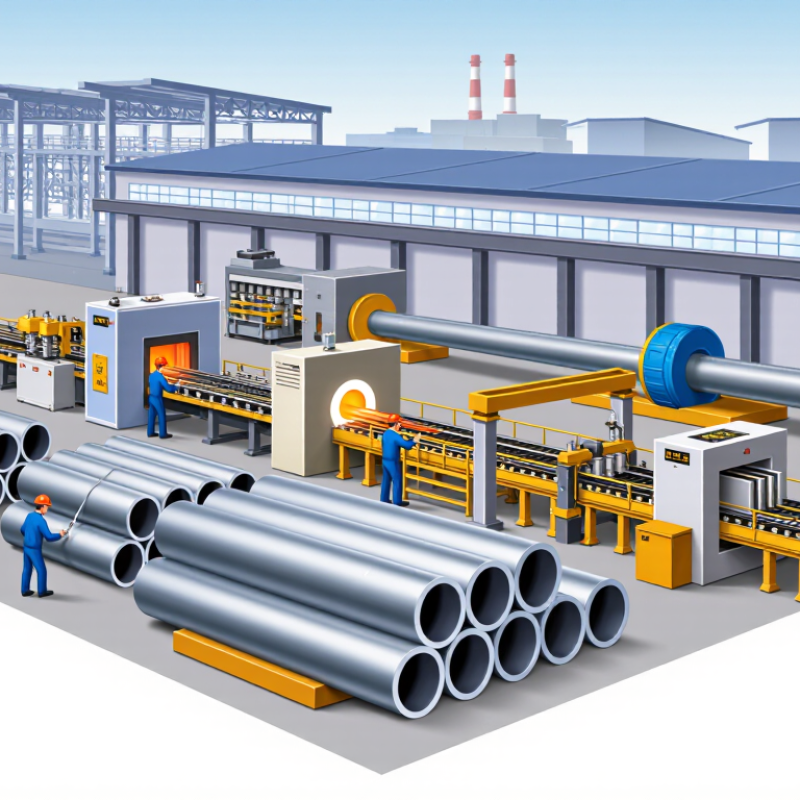
Manufacturing starts with carefully selected round steel billets. Chemical composition is checked before heating begins. Billets usually enter a rotary hearth furnace at controlled temperatures. Proper heating supports clean piercing and reduces internal stress.
A piercing mill then forms the hollow shell without welding. Mandrel elongation controls the initial wall thickness. Pilger or hot rolling equipment develops the pipe’s diameter and gauge. Heavy-wall SCH80 products require stable pressure and accurate tooling. Small temperature changes can affect ovality and surface quality.
The pipe passes through sizing equipment after rolling. Cold finishing may improve straightness and dimensional accuracy. Heat treatment restores toughness and relieves forming stress. Inspectors check wall thickness at several points around the circumference. They also verify outside diameter, length, hardness, and surface condition.
Hydrostatic testing can reveal leakage risks. Ultrasonic inspection helps locate hidden discontinuities. Production records should connect each pipe with its heat number and test results. Reliable factories also examine end preparation and protective packaging. A minor flaw can become expensive during installation. The process is controlled, not perfect. Experienced engineers still review unusual readings instead of accepting every automated result. Some production lines could improve data sharing between inspection and rolling teams. That gap deserves attention.
China’s SCH80 heavy wall seamless pipe production depends on controlled chemistry, piercing, rolling, and heat treatment. SCH80 describes wall thickness, not steel grade. Common carbon steel choices include ASTM A106 Grade B for high-temperature service and ASTM A53 Grade B for general pressure applications. ASTM A106 Grade B requires 60 ksi minimum tensile strength and 35 ksi minimum yield strength.
Dimensions require equal attention. ASME B36.10M lists a 2-inch SCH80 pipe with a 2.375-inch outside diameter and 0.218-inch wall thickness.
A 6-inch SCH80 pipe measures 6.625 inches outside diameter, with a 0.432-inch wall. These dimensions affect weight, internal flow, welding preparation, and pressure calculations.
Actual tolerance checks should follow the purchase specification, not a catalog alone.
Material traceability remains practical evidence of factory reliability. Test certificates should identify heat numbers, chemical analysis, tensile results, hydrostatic testing, and non-destructive examination.
The World Steel Association reported 1,892.2 million tonnes of global crude steel production in 2023, including about 1,019.1 million tonnes from China (World Steel in Figures 2024). Large output does not automatically prove seamless pipe quality. It only shows manufacturing capacity.
Some dimensions still need verification. Surface inspection can miss internal discontinuities, so ultrasonic testing may be necessary under the applicable specification. Small documentation gaps can create large project risks.
Quality control for SCH80 heavy wall seamless pipe begins with traceable materials. Factory staff should match each pipe to its heat number and review the required grade, dimensions, and purchase specification. During production, inspectors check surface condition, outside diameter, length, and wall thickness. A handheld ultrasonic gauge can reveal thickness variation around the pipe. Small details matter.
Testing should follow the order requirements and applicable technical standard. Depending on the specification, checks may include hydrostatic testing, ultrasonic examination, and tensile or impact testing. Instruments need calibration, and results should connect clearly to the pipe’s identification marks. Inspectors should record both accepted results and defects, rather than relying on a final visual check. A tidy report is useful, but it cannot replace sound sampling or careful handling. Even experienced teams can miss issues when paperwork and physical markings do not match.
Tips: Ask for material certificates and inspection records linked to the heat number. Confirm the test scope before production, and clarify how nonconforming pieces are separated. Check a few pipe ends and measured points yourself. It takes time, but assumptions are not quality control.
When selecting a China SCH80 heavy wall seamless pipe factory, verify it can consistently produce your required size range.
Do not judge a supplier by polished photos or a low quotation alone. Ask the factory to identify the governing pipe standard, steel grade, heat number, and dimensional tolerances in writing.
Look for traceable material records, test reports, and clear inspection procedures. Small details matter. A reliable supplier should explain how it handles rejected pieces, product marking, packing, and shipment delays.
Request recent production samples or inspection records for comparable sizes, not unrelated products. Check whether the mill owns the production line or outsources key steps, and ask who performs final inspection.
Confirm capacity, realistic lead times, and whether third-party inspection can be arranged before production starts.
Compare quotations line by line, including end finish, length tolerance, documentation, and packing.
If answers differ between sales and technical staff, pause. That is not proof of poor quality, but it deserves clarification.
Price is only one signal. Written records help, yet specifications can still leave gaps. Discuss those gaps early.
This content is restricted to site members. If you are an existing user, please log in. New users may register … LEARN MORE “Lighting Power & Control-Signal Cable”
We are here to help. You can contact us or create an account online to have access to special products, technical specifications and our new online quote tool.
ELECTRO CABLES
9 Riverside Drive
P.O. Box 276
Trenton, Ontario
CANADA K8V 5R5
N.A. Toll Free: 888-ELECTRO
(1-888-353-2876)
World: 613-394-4896
Fax: 613-394-4101
Email: sale@machinecables.com
We manufacture cables that are certified by the Canadian Standards Association (CSA), listed by Underwriters Laboratories and/or listed by Intertek (ETL).
Our quality management system is registered to ISO 9001: 2015. Our team is dedicated to consistently providing quality service and products to our customers.
© 2025 ELECTRO CABLES • SITE BY SNAP 360•