A partner you can trust
Choosing a shore power cable supplier in 2026 requires more than comparing prices or browsing polished websites. Global buyers need dependable products for ports, shipyards, terminals, and vessel retrofit projects. A cable may look suitable in a product image, yet fail during repeated bending, saltwater exposure, or cold-weather handling. Real performance matters.
This guide reviews leading shore power cable suppliers for international buyers. It considers manufacturing experience, technical documentation, testing practices, customization ability, and export support. Key details include voltage ratings, current capacity, conductor design, insulation quality, bend radius, connector compatibility, and resistance to oil, water, and ultraviolet exposure. Compliance with relevant IEC, IEEE, and port-specific requirements also deserves careful review.
Supplier claims should not be accepted without evidence. Ask for test reports, inspection records, material specifications, and references from comparable marine projects. A reliable supplier should explain production controls clearly and respond with precise engineering data. Delivery planning matters too, especially when cables require special lengths, reels, connectors, or labeling.
Not every reputable supplier fits every project.
Some vendors offer excellent technical quality but limited regional support. Others provide fast delivery but weaker customization. This guide recognizes that gap and compares practical strengths rather than promising a perfect ranking. Buyers should still verify certificates, current standards, warranty terms, and after-sales service before signing contracts. The best choice balances safety, durability, documentation, and total operating cost. That balance can prevent delays beside the berth and reduce costly cable replacement later.
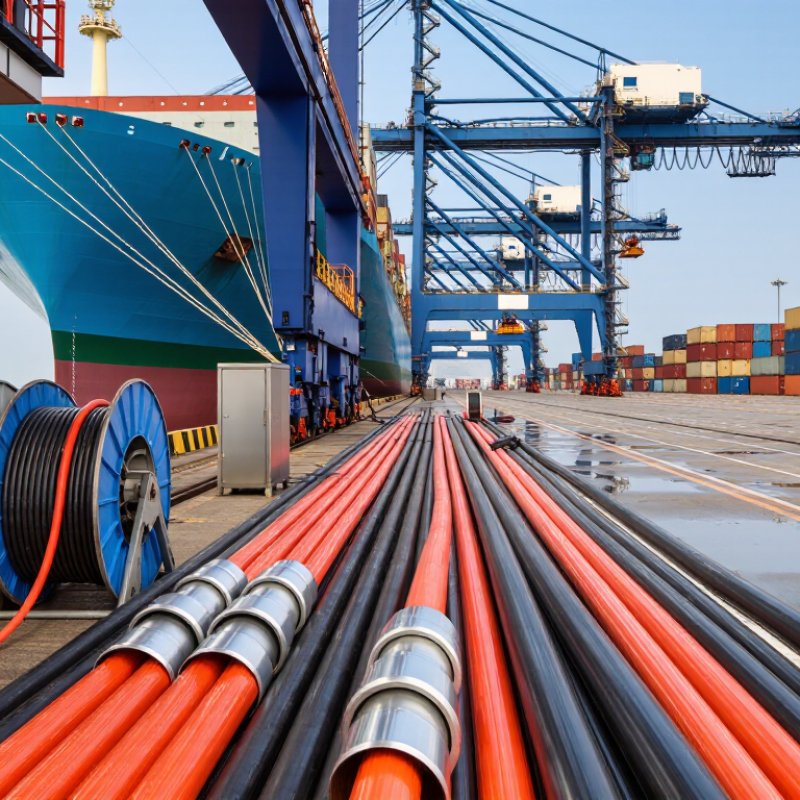
Shore power cables connect a vessel to electricity at berth, allowing onboard generators to shut down. This reduces local exhaust, noise, and fuel use during port stays. The cable must carry high current safely across a demanding working area. Salt spray, rain, oil, repeated bending, and heavy handling can quickly expose weak construction.
Applications range from commercial ships and ferries to offshore vessels, harbor craft, and specialized port equipment. Cable selection depends on voltage, current, length, connector design, and installation method. A long cable may create voltage drop and extra handling risks. Flexible insulation, strong strain relief, clear phase identification, and suitable ingress protection improve daily operation. Small details matter.
Global projects often reference IEC/ISO/IEEE 80005 for high-voltage shore connection systems. Other requirements may come from local electrical codes, port rules, classification bodies, and vessel specifications. Standards should be checked for the project location and equipment configuration. They are not interchangeable by assumption. In practical inspections, technicians should examine jacket damage, connector locking, grounding continuity, and heat marks before energizing. Records should include test dates and cable identity.
A perfect specification is uncommon. Real sites change, and early drawings may miss tide movement, vehicle traffic, or limited storage space. That is why experienced buyers should review the cable after a berth trial, not only from a datasheet.
2026 Top Shore Power Cable Suppliers for Global Buyers
Selecting a shore power cable supplier requires more than comparing prices. Start with voltage, current rating, conductor size, and cable length. These values must match the vessel’s shore connection and onboard distribution system. Ask for insulation and jacket materials suited to sunlight, oil, moisture, and saltwater exposure. A cable that feels flexible in a warehouse may stiffen badly on a cold dock.
Check the supplier’s technical documentation carefully. It should show operating temperature, bend radius, ingress protection, connector compatibility, and flame performance. Request test reports, batch traceability, and production inspection records. Reliable suppliers explain how they control conductor resistance and terminal crimping. They should also provide samples before large orders. Certification matters, but certificates alone cannot prove field durability. That is an easy detail to overlook.
Tips: Compare real specifications, not marketing terms. Confirm delivery times, replacement support, and minimum order quantities. Ask how cables are packed for humid transport. Examine one sample after repeated bending and connector mating. This simple test can reveal weak strain relief. Do not ignore regional plug requirements or vessel-side space limits. I have seen purchasing plans fail because the cable length looked correct on paper. Measure the route, including bends and working slack. No checklist is perfect. Leave room for a second technical review.
The chart presents common shore connection voltage classes used in global marine electrical systems: low voltage at approximately 0.4 kV, and high voltage at 6.6 kV and 11 kV. When evaluating suppliers, buyers should confirm voltage rating, continuous current capacity, 50/60 Hz compatibility, conductor construction, insulation performance, mechanical flexibility, ingress protection, bend radius, marine approvals, and testing documentation.
Reference basis: IEC/ISO/IEEE 80005 shore connection applications. Actual cable selection must match the vessel, shore-side system, installation method, environmental conditions, and applicable project standards.
Global buyers are seeking shore power cable suppliers with consistent quality, clear documentation, and practical marine experience. Reliable suppliers should provide cables suited to port environments, vessel connections, and repeated handling. Important details include voltage ratings, conductor materials, insulation type, bend radius, connector compatibility, and resistance to saltwater exposure. A strong supplier also explains testing methods instead of offering vague compliance claims.
Experience matters during installation. Cables may face tight storage areas, wet decks, heavy movement, and sudden temperature changes. Suppliers should offer suitable lengths, reinforced jackets, secure reels, and clear handling instructions. Factory inspection records, batch traceability, and sample testing can reduce purchasing risks. However, a polished certificate does not guarantee perfect field performance. Buyers should request recent test reports and inspect sample products before large orders.
Tips: Compare at least three suppliers using the same technical checklist. Ask about production capacity, delivery controls, warranty terms, and replacement procedures. Confirm whether custom connectors require additional testing. Check flexibility by bending a sample under safe conditions. Small details matter. I have learned that one overlooked cable gland can delay an entire installation. Buyers should also review communication quality, because unclear technical replies often create larger problems later.
UNCTAD’s Review of Maritime Transport 2024 recorded about 12.3 billion tonnes of seaborne trade in 2023. That scale makes reliable shore power cables commercially important. The IMO Fourth GHG Study 2020 estimated shipping produced 2.89% of global anthropogenic emissions in 2018. Buyers should therefore compare suppliers beyond catalogue prices.
Quality starts with documented conductor resistance, insulation thickness, bending radius, and heat performance. Ask for routine-test reports for every production batch. IEC/IEEE 80005-1 compatibility is important for high-voltage shore connection systems. IEC 60502-1 may also apply to relevant low-voltage cable designs. ISO 9001 supports process control, while class-society type approval can strengthen marine acceptance. Certification alone is not enough. Verify scope, validity, and testing laboratory details.
Pricing should show copper-index formulas, minimum order quantities, tooling charges, and warranty terms. Compare landed cost, not only the factory quotation. Delivery comparisons need production lead time, inspection time, packing method, and port-handling responsibility. A practical benchmark is a written schedule with milestone dates and delay remedies. Suppliers offering ten-week delivery may still need four weeks for testing and export documents. That detail is easy to miss. UNCTAD also reported continued disruption risks across major shipping routes in 2024, so buyers should request buffer stock or dual production capacity. I would not select the cheapest offer automatically; unusually low pricing often deserves a second technical review.
2026 Top Shore Power Cable Suppliers for Global Buyers
Global buyers should evaluate shore power cables as engineered systems, not simple electrical accessories. UNCTAD’s Review of Maritime Transport 2024 reports that ships carry over 80% of global merchandise trade by volume. Port electrification therefore affects large, time-sensitive operations. The IMO 2023 GHG Strategy targets net-zero emissions from international shipping around 2050. Buyers should check voltage, frequency, rated current, connector compatibility, bend radius, and cable length. IEC/ISO/IEEE 80005-1 compliance is a practical starting point. Ask suppliers for type-test reports, material declarations, inspection records, and traceable batch information.
Tips: Compare total operating cost, not only purchase price. A cable with stronger abrasion resistance may reduce replacement work. Confirm whether the supplier has tested cables under salt spray, repeated coiling, and low temperatures. Request photographs of drum handling and connector storage. Small details matter.
Experience from port projects also shows a common weakness: specifications are sometimes copied without matching the vessel’s actual interface. That mistake can delay installation. The European Maritime Safety Agency’s European Maritime Transport Environmental Report 2025 links shore-side electricity with lower port emissions, but benefits depend on electricity generation and reliable connection use. Buyers should request measured resistance, thermal performance, and voltage-drop data. Independent laboratory verification adds credibility. Still, certificates alone are not enough. I would review field references, failure records, response times, and warranty exclusions. Some procurement decisions remain uncertain because port infrastructure differs widely. That uncertainty deserves a written risk assessment.
Global buyer evaluation matrix based on technical compliance, operating conditions, customization capability, logistics, and total procurement risk
| Supplier Evaluation Area | Recommended Technical or Commercial Benchmark | What Global Buyers Should Verify | Typical Documentation Required | Procurement Importance | Suggested Buyer Scoring Weight |
|---|---|---|---|---|---|
| Applicable Standards | Compliance with the vessel, port, and regional requirements applicable to the project, commonly including IEC/ISO/IEEE 80005 series requirements for high-voltage shore connection systems. | Confirm that the cable assembly, plug, socket, interlock, and protection system are evaluated as one compatible system rather than as isolated components. | Declaration of conformity, standard-compliance statement, type-test reports, and product technical file. | Critical | 20% |
| Rated Voltage | Low-voltage marine shore-power cables may be designed for systems such as 0.6/1 kV, while high-voltage shore connection systems commonly operate at 6.6 kV or 11 kV, subject to project requirements. | Match the cable voltage rating with the vessel inlet, shore connection equipment, transformer arrangement, and local electrical code. | Voltage-rating datasheet, insulation-system specification, routine-test records, and compatibility declaration. | Critical | 15% |
| Conductor and Core Configuration | Common designs include copper conductors with flexible stranded construction; the number of cores and conductor cross-section depend on current, grounding, pilot, and communication requirements. | Check conductor material, cross-sectional area, class of flexibility, screen or earth-conductor arrangement, and compatibility with the termination kit. | Construction drawing, conductor resistance data, cable schedule, and material declaration. | Critical | 12% |
| Current-Carrying Capacity | Allowable current must be calculated for the actual installation method, ambient temperature, grouping, duty cycle, and permissible voltage drop. A single catalogue ampacity should not be used for every application. | Request ampacity calculations for free-air, reel, tray, or bundled installation and identify all derating factors. | Current-capacity calculation, voltage-drop calculation, thermal rating, and installation assumptions. | Critical | 15% |
| Marine Jacket Performance | Use a flexible, oil-resistant, water-resistant, flame-retardant, and low-smoke or halogen-free construction where required by the vessel and port environment. | Verify resistance to seawater, fuel and lubricating oils, abrasion, ultraviolet exposure, ozone, and repeated handling. | Material datasheet, flame-test report, oil-resistance test, water-resistance test, and environmental test results. | High | 12% |
| Mechanical Flexibility | The cable should be suitable for repeated connection, disconnection, bending, and controlled storage. The minimum dynamic bending radius must be stated by the manufacturer. | Compare minimum bending radius, tensile strength, crush resistance, torsion performance, and expected flexing cycles. | Mechanical properties, bending-radius specification, flexing-cycle test, and handling instructions. | High | 10% |
| Connector and Termination Compatibility | Connector size, keying, pilot contacts, protective earth, interlock, phase sequence, and cable gland dimensions must match the shore connection system. | Confirm interface drawings before ordering and require a complete assembly check if the cable is supplied with plugs or sockets. | Interface drawing, pinout, termination procedure, torque values, and assembly inspection report. | Critical | 12% |
| Temperature Rating | Typical marine cable designs may use conductor operating temperatures around 90°C, but the actual rating depends on insulation and jacket materials. | Verify continuous operating temperature, short-circuit temperature, ambient-temperature range, and cold-flexibility rating. | Temperature-rating table, thermal-aging results, short-circuit rating, and cold-bend test report. | High | 8% |
| Length and Handling Configuration | Supply length should reflect the vessel-to-quay distance, movement allowance, bend radius, connection arrangement, and storage method. Reel or drum supply may be appropriate for long lengths. | Confirm maximum continuous length, preferred delivery length, drum dimensions, cable mass, lifting points, and storage requirements. | Length tolerance, packing specification, drum drawing, gross weight, and handling instructions. | High | 6% |
| Testing and Quality Control | Every finished cable should undergo the applicable routine electrical tests, while representative or project-specific type tests should be available for critical applications. | Ask whether tests are performed in-house or by an independent laboratory and confirm traceability from raw material to finished cable. | Routine-test certificate, type-test report, inspection and test plan, calibration records, and batch traceability. | Critical | 15% |
| Customization Capability | Potential customization may include conductor size, core configuration, jacket color, identification marking, connector assembly, pilot wires, communication conductors, and cut-to-length production. | Evaluate engineering support, drawing approval process, sample availability, minimum order quantity, and change-control procedure. | Approved drawing, bill of materials, sample inspection report, change-control record, and production approval document. | Medium to High | 8% |
| Lead Time and Capacity | Actual lead time depends on conductor availability, connector procurement, custom tooling, testing, order quantity, and export documentation; it should be confirmed in writing for each purchase order. | Check monthly production capacity, raw-material allocation, promised ship date, expediting options, and contingency planning. | Production schedule, capacity statement, order acknowledgment, manufacturing plan, and shipment milestone schedule. | High | 8% |
| International Logistics | For overseas deliveries, the buyer should define Incoterms, export packing, customs classification, insurance responsibility, and destination-port requirements before placing the order. | Compare delivered cost rather than factory price alone, including freight, duties, inland transport, inspection, and insurance. | Commercial invoice, packing list, certificate of origin, export declaration, transport document, and insurance certificate where applicable. | High | 8% |
| Warranty and Technical Support | Warranty terms should clearly define coverage period, installation conditions, exclusions, response time, replacement procedure, and responsibility for field inspection. | Confirm access to engineering support, installation guidance, troubleshooting assistance, and spare connector or termination components. | Warranty certificate, service-level agreement, installation manual, troubleshooting guide, and claims procedure. | Medium to High | 6% |
| Total Cost of Ownership | Evaluate purchase price together with connectors, testing, freight, installation labor, storage equipment, expected service life, maintenance, and replacement risk. | Use a five-year or project-life cost model and compare technically equivalent offers only. | Itemized quotation, lifecycle-cost model, spare-parts pricing, maintenance schedule, and replacement-cost assumptions. | Critical | 15% |
Buyer note: Technical ratings and compliance requirements vary by vessel, port infrastructure, cable assembly, installation method, and jurisdiction. Final selection should be based on approved project drawings, applicable standards, verified test documentation, and a documented installation-specific ampacity calculation.
This content is restricted to site members. If you are an existing user, please log in. New users may register … LEARN MORE “Lighting Power & Control-Signal Cable”
We are here to help. You can contact us or create an account online to have access to special products, technical specifications and our new online quote tool.
ELECTRO CABLES
9 Riverside Drive
P.O. Box 276
Trenton, Ontario
CANADA K8V 5R5
N.A. Toll Free: 888-ELECTRO
(1-888-353-2876)
World: 613-394-4896
Fax: 613-394-4101
Email: sale@machinecables.com
We manufacture cables that are certified by the Canadian Standards Association (CSA), listed by Underwriters Laboratories and/or listed by Intertek (ETL).
Our quality management system is registered to ISO 9001: 2015. Our team is dedicated to consistently providing quality service and products to our customers.

© 2025 ELECTRO CABLES • SITE BY SNAP 360•