
Top 10 Types of Wire and Cable and Their Uses
Wire & cable are easy to overlook until a motor stops, a building is wired, or a charging station needs power. Yet the right type matters. A flexible cord in a workshop, a buried power cable, and a data cable serve different purposes. Their conductors, insulation, shielding, and construction affect performance and safety.
The International Energy Agency’s Electricity Grids and Secure Energy Transitions report estimates that the world must add or replace 80 million kilometers of electricity grids by 2040. That is roughly the length of the existing global grid. The IEA’s Global EV Outlook 2024 also reports nearly 14 million electric-car sales in 2023, about 18% of all car sales. These shifts increase demand for dependable power connections, charging equipment, and communications infrastructure. The details matter.
This guide introduces ten common types of wire and cable and explains where each is typically used. It covers familiar options, including building wire, coaxial cable, fiber-optic cable, and flexible cord, while distinguishing their practical roles. Some categories overlap; real installations are not always as tidy as product lists suggest. Selection depends on voltage, environment, movement, and the equipment being connected. Check the manufacturer’s specifications. A type name alone cannot confirm suitability. When a project involves permanent wiring or high power, qualified professionals and applicable standards should guide the final choice.
What Wire and Cable Are and How They Differ
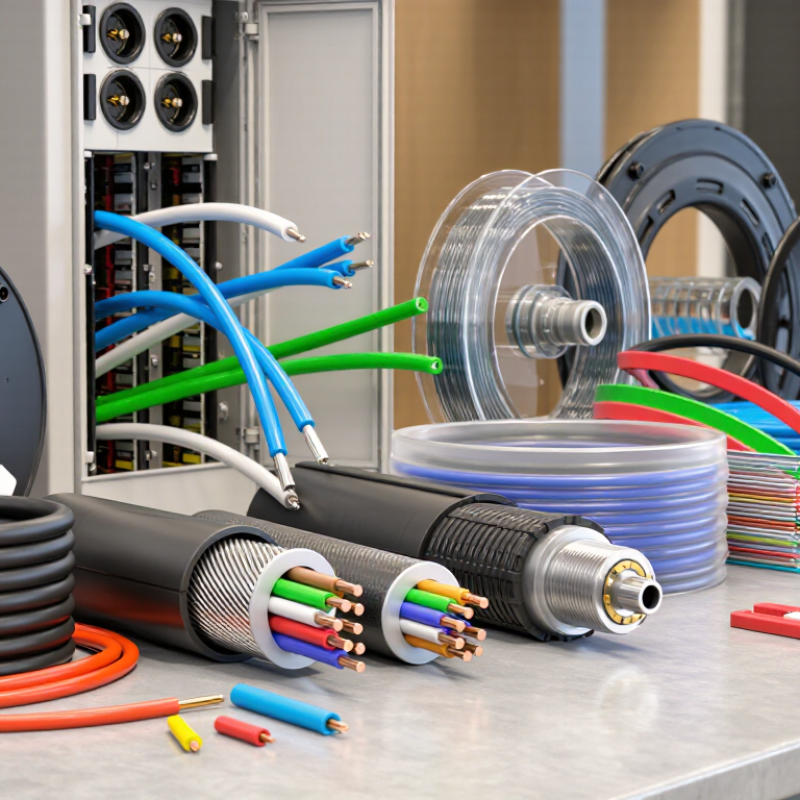
A wire is a conductor that carries electrical current or signals. It is often made from copper or aluminum, with insulation around it to limit contact and protect the conductor. A wire may be solid, with one continuous metal core, or stranded, with many thin strands twisted together. Solid wire holds its shape well in fixed installations. Stranded wire bends more easily.
A cable groups one or more conductors into a single assembly. The conductors may have separate insulation, while an outer jacket helps protect them from abrasion, moisture, or other conditions. A simple household cable might contain insulated conductors beneath a shared jacket. More complex designs can include shielding or layers for specific tasks. Not always.
The difference is not just size. A thick wire is still usually one conductor; a cable is defined by its assembled construction. Common terms can vary between industries, so check the product’s conductor count, insulation, voltage rating, and environment requirements. A coaxial cable, for example, has a central conductor, insulating material, and a surrounding shield. Fiber-optic cable carries light rather than electrical current. These details matter when choosing a type: a flexible cord for a moving tool has different needs from fixed wiring inside a wall. I would not select by appearance alone. A neat outer jacket can hide an unsuitable internal construction.
Top 10 Types of Wire and Cable and Their Uses - What Wire and Cable Are and How They Differ
A wire is typically a single electrical conductor, while a cable groups two or more insulated conductors, or conductors with protective components, inside a common sheath. The right choice depends on the application, environment, electrical rating, and applicable installation rules.
| Type | Typical construction | Common uses | How it differs |
|---|---|---|---|
| 1. Building wire (THHN/THWN-2) | Usually a single copper or aluminum conductor with thermoplastic insulation; commonly installed inside conduit or raceway. | Branch circuits, feeders, and other building wiring where the conductor is installed in an approved raceway. | Often supplied as individual conductors rather than as a multi-conductor cable. The exact permitted use depends on its markings and local electrical code. |
| 2. Nonmetallic-sheathed cable (NM-B) | Two or more insulated conductors, usually including a bare grounding conductor, enclosed in a flexible nonmetallic sheath. | Commonly used for residential branch-circuit wiring in dry, concealed locations where permitted. | Combines multiple conductors in one outer sheath and is generally installed without conduit in approved indoor applications. It is not intended for wet locations. |
| 3. Underground feeder cable (UF-B) | Insulated conductors enclosed in a solid, moisture-resistant nonmetallic assembly, typically with an equipment grounding conductor. | Outdoor circuits and underground wiring installations when the cable type, burial method, and installation comply with applicable rules. | Designed for exposure to damp or wet conditions and permitted direct burial in suitable installations; burial depth and protection requirements vary. |
| 4. Coaxial cable | A central conductor surrounded by dielectric insulation, a conductive shield, and an outer jacket. | Radio-frequency signals, television distribution, antennas, and some broadband connections. | The concentric shield helps control electromagnetic interference and signal leakage, making it suited to high-frequency signal transmission. |
| 5. Twisted-pair data cable | Pairs of insulated copper conductors twisted together; many versions also include an overall shield or individual pair shielding. | Ethernet networks, telephone wiring, and other low-voltage data or communications systems. | Twisting helps reduce interference and crosstalk. Performance depends on the cable category, installation quality, length, and connected equipment. |
| 6. Fiber-optic cable | One or more glass or plastic optical fibers protected by coatings, strength members, and an outer jacket. | High-speed data networks, telecommunications, and links that require long distances or electrical isolation. | Transmits information as light rather than electrical current. It is not affected by electromagnetic interference, but requires compatible optical equipment. |
| 7. Metal-clad cable (MC) | Insulated conductors and a grounding conductor protected by an interlocked metal armor or another approved metallic covering. | Power and lighting circuits in commercial, industrial, and other locations where the cable type is permitted. | Its metal armor provides mechanical protection. The armor and grounding arrangement must match the cable listing and installation requirements. |
| 8. Tray cable (TC) | One or more insulated conductors, often with an overall jacket, listed for installation in cable trays and other specified applications. | Power, control, and instrumentation wiring in industrial facilities and other installations that use cable tray systems. | Selected for its approved tray use and available conductor configurations. Direct-burial or outdoor use requires the appropriate markings and listing. |
| 9. Welding cable | Fine-stranded copper conductors with flexible insulation, commonly made to withstand repeated movement and job-site handling. | Connections between welding equipment and the electrode holder or work clamp, when appropriately rated for the equipment and conditions. | Its flexibility suits portable welding connections; it is not a general substitute for building wiring and must be selected for the required current and duty cycle. |
| 10. Flexible power cord | Two or more flexible insulated conductors assembled under a protective outer jacket; conductor count and jacket type vary by cord designation. | Portable appliances, tools, and equipment where a flexible cord is permitted by the product rating and applicable rules. | Designed for movement and temporary or equipment connections, not as a replacement for permanent building wiring unless specifically approved for that use. |
Always check the cable markings, conductor size, voltage and temperature ratings, environmental suitability, and local electrical requirements before selecting or installing wire or cable.
Related Posts
Our quality management system is registered to ISO 9001: 2015. Our team is dedicated to consistently providing quality service and products to our customers.